

HomeFQ&A—Miscellaneous

Flag Questions and Answers (FQ&A)

Miscellaneous Questions

Creating a Burgee for a Revolutionary War-Era Boat (4/9/26)


Massacre at Long Beach

Q: At my workplace we have made a miniature privateering whaleboat and would like to have a burgee with it.  We have named it
Hero’s Revenge, which was the name that a local loyalist pine robber and privateer John Bacon gave his boat.  Do you know of any Revolutionary War-era designs of burgees I could take inspiration from? — R. Joseph Latshaw III, Ocean County Cultural & Heritage Commission


A: There were no flags called "burgees" at the time of the American Revolution.  These evolved from yacht club signals in the U.K. starting in the 1790s, acquiring the name in the early 19th century.  The term came to America in the 1850s.  To identify what colors to display on a Revolutionary privateer, you have to know who issued that vessel’s letters of marque.  For example, if it was Massachusetts, then the pine tree “jack” (the term has a different meaning today than it did then) would have been displayed.  If it was the Congress, then there are other designs used depending on the dating of the letters.  British-issued letters would subject the vessel to display British colors.  A whaleboat most likely had no colors as it would have had no permanent mast, but this is just my supposition.  To answer the question of what colors might have been used, we’d need to know who issued the letters of marque.  Without letters of marque, they were pirates and subjects of no flag.  Bacon would almost certainly have flown no flag by which he could be positively identified unless he had been issued letters of marque, which it sounds like he was not. — David B. Martucci, past president, NAVA

A: I'd add to David's excellent answer that the term Pine Tree flag or ensign is a generic name for a number of flags used by the New England and Massachusetts colonies from 1686 to 1778.  The Pine Tree has been a popular symbol of American independence in New England for years.  They were all handmade and each one was different.  Imagine how many ways there are to draw a pine tree!  Visit my Historical Flags of Our Ancestors and scroll down to the section "Pine Tree Flags and Naval Ensigns" to see a number of designs elements you might choose to include in your "modern" burgee design. — Pete Loeser, NAVA Website Editor.


Sizing a flag appropriate to a pole (11/5/25)
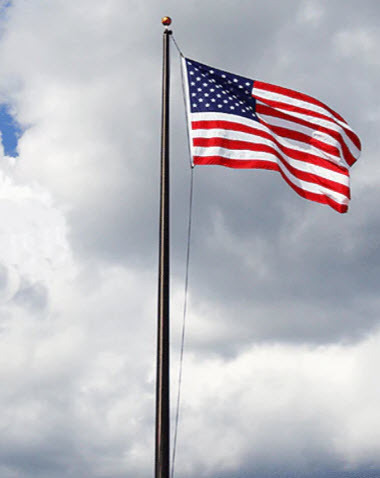
 

US Flag on 60-foot pole


Q: Our school flies a 20′×30′ flag on a 60′ flagpole.  The pole manufacturer has confirmed that it is rated for this flag.  While many in our community find the display beautiful and fitting, others have a concern the flag appears oversized relative to the pole and suggest a taller pole (we all like the flag size).  I am aware of aesthetic guidelines for ratios but am unaware of any codes or legal restrictions that would prohibit our configuration.  To help our community reach a fair and informed conclusion, I would greatly appreciate a professional opinion from NAVA regarding whether our current setup is acceptable.  We deeply value the symbolic and emotional importance of the flag and want to ensure it is displayed with the dignity and respect it deserves.  We also must be mindful of public resources and the expense of a new pole.  I would be grateful for any insight you can provide. — Joe Bowen, Ithaca Public Schools, Ithaca, Michigan.


A: Thanks for the interesting query.  As you have observed, there don't seem to be any codes or ordinances regarding the flag to pole sizes.  However, the generally accepted practice used by civilians is the 1:5 ratio where the length of the flag or its hypotenuse should be approximately one-fifth the height of the flagpole.  This generally provides a handsome and effective display which prevents the flag from looking too small or placing excessive strain on the flagpole.

However, there can be many good reasons for deviation from this practice:
    • Wind conditions: In high-wind areas, a smaller flag or a thicker, stronger flagpole may be preferable.
    • Pole strength: The flagpole's strength rating may not be able to handle the size of the flag you intend to fly.
    • Nearby obstructions: The pole may be placed near or adjacent to trees, powerlines, other flagpoles, or other buildings or architectural features and thus require a smaller flag.
    • Aesthetics: For historical, patriotic, or visual reasons a flag’s size may be increased for the following reasons: Increased visibility for distance viewing / visual impact, Proportionality for large structures, National pride, Ceremonial use, Prestige, or Personal preference.
It might be of interest to note that the U.S. Army specifies three different size flags for the main pole on an army base.
    (1) Garrison flag—20’ x 38’, flown on designated holidays,
    (2) Post flag—8’, 11 3/8” x 17’, flown daily,
    (3) Storm flag—5’ x 9’, flown in inclement weather.
Note that the flag’s size changes upon need. — Jim Ferrigan, NAVA protocol officer.


Storing flags for 30–40 years (2/27/25)

Flag Storage Box

Q: The Watsonville Police Department (in California) is looking to start a tradition of flying American flags on our officers’ first shifts then storing the flags until their last day of employment (could be 30–40 years).  I know nothing about storage or the best flag material for storage and am looking for your expertise or guidance.  I watched a YouTube presentation of yours and flat storage really isn’t an option for storing 70–100 flags due to space limitations.  I look forward to any information you can provide. — Sergeant Ely Uretsky, Watsonville Police Department


A:  This is an intriguing idea.  The optimal way to store flags is flat, but if that’s not an option, then rolled, and if space constraints preclude that, then folded.  It sounds like folding in this case.  Since each flag is specific to an officer, individual storage would be optimal after first use and tagging.  My recommendation would be to use the original box.  (Do not seal the flag in plastic—Nylon off-gasses and plastic breaks down.)  For long-term storage, and to prevent contact with the non-archival cardboard, the best method would be to layer the flag with one thickness of acid-free tissue paper, available in sheets from Gaylord.  Acid-free boxes are also available, but they can be expensive. — James J. Ferrigan III, Curator, The Zaricor Flag Collection.


Determining the official yellow of the Vatican City flag (12/12/24)

Vatican City Flag


Q: Is there an official Pantone color for the yellow on the Papal/Vatican City flag? — Gayle Lesovoy, Customer Service Manager, Flags.com

A: An official illustration of the Vatican City State flag can be found in Annex A of its most recent constitution (2023), online at: https://press.vatican.va/content/dam/salastampa/it/bollettino/documentazione-linkata/allegato_A.pdf.  The full constitution is online https://www.vatican.va/content/francesco/it/motu_proprio/documents/20230513-legge-fond-scv.html. No Pantone codes are specified, but the yellow skews toward a lighter shade (e.g. dandelion yellow).  This corresponds with actual practice at the Vatican, although a darker shade is occasionally used instead (e.g. orange-yellow).  More information is online at my website on Vatican flags (including links to my book on the topic) here — Rev. William M. Becker, author, Vatican Flags.


Knowing the number of flags of indigenous peoples (11/10/24)

   
Maori Flag

Q:  For peoples’ flags like the aboriginal Australians or the Maori flag, is there a concrete way to know how many of these types of flags are there? — Rhys, Hatch End High School, Harrow, London


A: Thanks for your inquiry regarding the flags of indigenous peoples.  Unfortunately, it is difficult to establish an exact number for the following reasons:

  1. Indigenous groups can be nested within each other.  In Australia, the Aboriginal people have a flag in general, but some individual tribes have their own flags as well.  In Aotearoa New Zealand, there is a Māori flag in general (the Tino Rangatiratanga flag), but some iwi and marae within that have their own flags.  In the U..S, there are federally recognized tribes, but there are also tribes, nations, and bands within those tribes, and even further levels going down.  The number would depend on where you draw the line at where one "people" begins and ends.
  2. Indigenous groups can have more than one flag.  For example, the Métis people of Canada have two flags, one blue and one red.  The Māori people have mostly settled on the Tino Rangatiratanga flag as their flag, but some of them prefer to use the United Tribes flag or Kīngitanga flags instead.
  3. Many indigenous groups and their flags are poorly documented, especially if they are small and obscure.
  4. As far as I know, there is no central registry that documents all indigenous peoples and their flags worldwide in one place.
For a rough guide, you could consult the members (current and former) of the Unrepresented Nations and Peoples Organization.  This organization includes a lot of indigenous nations, but it is not intended to be a registry of indigenous nations, as its scope includes other unrepresented people and territories.  For example, it includes Washington, D.C., but not the Māori people.

For a more comprehensive guide, Flags of the World (fotw.info) has a large index of North American indigenous nations.  However, the indices for other regions are organized by country, so you would have to seek out each one and count them up manually. — Brian Cham, moderator, NAVA’s Flag Design Forum and native New Zealander.


Finding a “Harlem Hellfighters” flag (9/12/24)

15th Regiment New York National Guard       
369th Regimant NY US Army

Q: One of our historians is seeking to locate a flag of the Harlem Hellfighters (369th Infantry) from World War I and I was wondering if you had heard of any such flags in private collections or potentially going up for auction.  Would you know of any place or individuals that have expertise in the segregated units of World War I that might know of where these flags can be located? – Ryan Oates, Assistant to the Chief Curator and Museum Department at the New-York Historical Society.


A: The flags you seek for the “Harlem Hellfighters” are held at the New York State Military Museum and Veterans Research Center.  They are catalogued under their New York State Infantry designation as the 15th New York Infantry.   Many state national guard units were renumbered when they were federalized, but many, like the Hellfighters, took their old colors to war.  Included is their color with the Federal designation.  Attached is an image of the surviving flags, as well as an image of the color for the 15th in France and then again in New York City upon their return.  The Federal color is likely post-war. – James J. Ferrigan III, curator, The Zaricor Collection.


Images located here:
 
15th Regiment: https://museum.dmna.ny.gov/flags/infantry/15th-regiment-ny-national-guard/15th-regiment-ny-national-guard-regimental-color-world-war-i 

369th Regiment:  https://museum.dmna.ny.gov/flags/infantry/369th-regiment-us-army/369th-regiment-us-army-regimental-color-c-1920

Determining the correct color and font for a Liberty Flag (9/10/24)

Liberty 1    Liberty 2       

Q: Huntington, New York, flew a Liberty Flag (see:https://www.huntingtonmilitia.com/liberty-flag.html); also attached is the Huntington Historical Society fact sheet with images) in 1776.  For the United States Semiquincentennial the Society wants several Liberty flags made for the event.  Do you know the color red that was used, or the font?  Obviously we'll select one close to the one they made years ago—as you can see on the website—but it would be so satisfying if we can create a more authentic looking flag.  Thank you for your help. – Susan Glaser, Glaser Mills and trustee, Huntington Historical Society.


A: No original flag survives; all modern versions are conjectural reconstructions.  Since, by repute, it was made from a British Red Ensign it would have been the standard British red (likely equivalent to Pantone 186 C).  Most modern images use a sans-serif font, which is minimally adequate.  Should the Society wish to mimic a surviving New York liberty flag, I recommend the 1771 Schenectady version (shown on the cover of Raven 31). – James J. Ferrigan III, curator, The Zaricor Collection.


Understanding U.S. & U.K. flags in an early 1800s glass clock face (6/27/24)

Clock Face Flags 1800s Early 1800s glass clock face

Q:  I recently came upon a glass tablet from an early American clock.  It is somewhat unique in that the design is rendered by silvering the background, leaving the design in the clear glass.  The composition is of an Eagle and a Lion standing on a land mass, with the Lion clutching an anchor in one paw and a flag/banner in the other.  The flag resembles an “upside-down” early Union Jack.  The Eagle, facing the Lion, is standing on the anchor and has a flag similar to the U.S. flag.  It is composed of 9 stripes and the blue corner has 17 stars arranged around the profile of another Eagle.  The flag staffs are crossed.  I’m hoping for anyone who might recognize the design or otherwise offer ideas as to what is being represented in this glass.  I believe the glass to be from an early 1800s American clock, based on one other similar tablet from a dated Forestville clock, as well as the glass itself.  It is plainly very old, hand-blown glass. — Fred Fletcher


A:  This appears to be an allegorical scene depicting the British Lion and an American Eagle with their respective stylized flags, mounted with cords and tassels, on a compartment sporting stylized leaves and grass, from which two staffs or rods emerge supporting a stylized Phrygian or “liberty” cap.  On the compartment, depicted horizontally, is a stylized fouled anchor, a paw of the British lion is on the upper arm of the anchor below the fluke while the American eagle is standing atop the shank, the fouling rope trails on the compartment below.

The overall impression is one of American ascendancy.  The eagle is atop the anchor, its wings displayed, its gaze upon the flag.  Presumably the anchor represents the Royal Navy, depicted in a position inferior to the eagle.

The two flags are highly stylized.  The U.S. flag bears 17 six-pointed stars within the eagle canton.  Although never official, 17-star flags were current from 1803 to 1812 for a period of 9 years, 1 month and 27 days, after the admission of Ohio and before the admission of Louisiana. The eagle canton flags are known to have been used by the U.S. government in this period and were very popular as diplomatic gift flags when dealing with Native American Indian tribes.  The British flag appears to be a stylized and inverted red ensign of the style and type used from 1707 to 1801.  The additional lines likely indicate undulations or wear. — Jim Ferrigan, curator, The Zaricor Collection


A:  The clock vignette in question undoubtedly symbolizes the then-current conflict between the U.S. and Great Britain.  The version of the U.S. flag is a decent rendition of a common design pattern of the era utilizing the U.S. arms in the canton of the flag along with the stars.  The 17 stars are consistent with the era just before the War of 1812, caused in part by Britain’s impressment of American sailors into Royal Navy service—so it is significant the U.S. Eagle is standing on an anchor.

The British Lion’s flag is unintelligible, as is often the case with such allegories, and my impression is that it is a very poor rendition of the Red Ensign, more often used at the time to symbolize the British.


Below is an illustration of an actual 17-star U.S. flag (from the Chicago Historical Society) and a modern facsimile of a period red ensign, depicted as they are and as the artist may have intended.  — David B. Martucci, past president, NAVA


Image of surviving flag 17-star flag


Modern facsimile of the British ensign


Reversed and undulating


Inverted, worn, and undulating


Dealing with a Christian organization's symbolism resembling Denmark’s flag (12/16/23)

NACL Logo

Q: I hope flag enthusiasts like you can help me.  I am from Denmark, which as you obviously know, has the oldest national flag in the world the Dannebrog.   I am very proud of my country and our history.  On YouTube, I stumbled over an American organization that apparently abuses my national flag as theirs.  The sad part is, that the organization has the exact opposite values than the Danish flag represents.   Therefore, I naturally feel offended by the damage to the flag and country's reputation. The organization is called National Association Christian Lawyers — NACL.  I know the U.S. doesn’t have any protective laws on flags, so is there anything I can do? — Kim Boxenbaum, Denmark


A: It is unfortunate when similar symbols result in confusion about what they represent.  Both Denmark and the NACL use a white cross on a red field.   For both, the cross ultimately derives from Christianity.  However, I note that the NACL depicts the cross vertically in a shield and the Danish flag depicts it rotated horizontally on a rectangle, and the NACL version shows the vertical part expanding toward the base.  While this may not be enough to avoid confusion, at least they are not identical.  To answer your question, I don't believe there is anything you can do under U.S. law.  There may be a diplomatic avenue through your foreign ministry. — Ted Kaye, NAVA secretary


Determining if flagstaff finials have defined meanings (3/12/2023)

Flag Finials

Q: My teenage son has a political science class and is writing dissertation on the topic of martial law with an interesting aspect to which we are unable (so far) to find any reference material.  The subject matter concerns flags, rather specifically the meaning of the various types of “staff head” or “finial” ornaments which are used a-top of national flag guidons, such as: eagle (wings out and up), eagle (wings out but down), acorn, ball, flat truck, Roman spear (pointed spearhead), “spade” spearhead, star, etc.  We see the pointed “Roman” spearhead all the time, all over the world in all nations, especially with politicians making announcements on camera stood in-front of their (respective) national flag, and especially in recent years.  Where I live all the embassies and consulate buildings sport these “spearhead” flag heads too (not the ball type).

We have an idea what these finials mean but we can find no source material (other than hearsay).  Perhaps you or members can help or have links to (retired) military folk who know.  We have scoured dozens of books on “flag etiquette”, “military law”, and encyclopedias.  We have looked at about a dozen books and journal papers on martial law (Geneva Conventions, the Lieber Code, 1863).  We expect/hope to find a kind of “look up” table which explains what these different flagstaff heads/finials mean.  We’ve looked for books on “flag symbology” too.  We can find books describing military symbols, codes, semaphore, etc., but it’s curious we find no explanation for WHY there are different ornaments...

I’m sure there are Army (or military) references, but they evade us so far.  For example, Army and Marine Corps regulations do contain a lot of details about flag etiquette, and the hand-held guidon (e.g., used in parades). These always have the spearhead (or “spade”) finial, but there is no mention of why (no reference to its meaning) — Phil Mathers


A: Thanks for your query.  The whole question of finials by any name, be they military or civilian, is interesting and fraught with myth and lore. The best internet site for the information you seek is: Sea Flags: Finials.  There the author mentions the Battle-Ax, Spread Eagle, Presidential Eagle, Halberd, Ball, Star, Flat Truck, and Spearhead.  It may interest you that the so-called Army Spear, the leaf-shaped finial, may be the oldest piece of unchanged American military hardware, having originated with the U.S. Mounted Troops in the 1830s.  Most of these were made outside Philadelphia, Pennsylvania, in a foundry in Phoenixville that was in business until the 1980s making top ornaments.  I do hope this helps your martial law project but remember that both the finial and the fringe are only ornamental and impart no significance to the flag under which they fly. — James J. Ferrigan III, curator, the Zaricor Flag Collection

A: FOTW is always a good place to start: See: Finials and Fringes on Flags.

  — Nick Artimovich, past NAVA president

A: See also the book on Civil War Finials. — Tom Carrier, CBFA member

A: I think the simple answer is that finials are strictly decorative and have no symbolic meaning.  A partial exception would be finials that are specifically associated with the symbolism of what the flag stands for, such as those holding the Maryland and Kentucky state flags and perhaps the eagle with the U.S. flag.  I suspect that the origins of most finial types are lost in the mists of history, although we can probably make fair guesses about some of them.  For example, it’s likely that the spear point descended from standards that were displayed on spears or lances. — Peter Ansoff, past NAVA President

A: Having had to grapple with similar inquiries back in my days commanding ceremonial units, I can answer on the military side, but with less certainty on the civil side.  I agree with Peter, finials are strictly decorative and not symbolic—and there’s not just one “grand reference”.  As with many things, “it depends”.  On top of that, the references detail requirements for finials, but no history/meaning for them...frankly, because it just doesn’t exist (it just developed over time).  In the U.S. military, Army practice and protocol tends to take precedence (the Navy, however, throws quite a few monkey wrenches, like pikes, into the mix)—as result, I would start with the current Army reference (the 2020 edition is the latest, I think, and it has pictures) and then defer to the Navy’s when naval issues arise (that’s just for overarching questions...the other services have peculiar requirements to consider).  Regarding the use of eagle finials on U.S. national flags in the military: the Army reference once stated that only the U.S. President rated an eagle finial on the colors of any type.  Other colors have their associated finial; spearhead for most, acorn/ball for others, etc.  On the civil side, there may be references for or from the White House and the State Department to which I would defer for non-military federal use, then to the states for that level, and to respective governments’ requirements below that... — Stanley K. Contrades (Col., USAF, ret'd.), NAVA president


Defining flag-interest terms (1/9/23)


Q:  Can you explain the difference between vexillologist, a vexillophile, and a flag historian?  — Newlen Sutton


A: In my view, a vexillologist studies flags (generally), a vexillophile enjoys flags, and a flag historian focuses on the history of flags as a part of vexillology.  The Flags of the World "Dictionary of Vexillology" provides a list of terms that may help to further answer your question. — Ted Kaye, NAVA secretary

Thank you so much.  This is very helpful.  I now have a title for myself: "Vexillophile — a collector of flags and information about flags".  — Newlen Sutton


Finding a list of flags to commemorate national events/celebrations (6/18/21)


Q: I am a member of my local town’s Community Relations Advisory Committee.  Our town recently put up a new flagpole next to our Municipal Building to commemorate national events. This is in addition to the American flag on a different flagpole.  We recently raised the Gay Pride flag on it.  At our most recent meeting I mentioned that I heard on a podcast, 99% Invisible, Roman Mars, a person you may have heard of, mention there is a Juneteenth Flag.  We will be flying that one as well.  The question was raised and I agreed to contact you — Are there other flags that we could raise to commemorate other national events — such as Black History Month, etc.  Can you direct me or inform me of other such flags? — Ronald S. Roth, Fair Lawn, New Jersey


A: I've asked around and failed to find any such list.  Here's a list of world-wide flag-flying days, but that's not what you're asking for: Flag Days of The World.  I'm not sure such a list exists, but it would be great to have.  You might try your local flag store, or NIFDA, the flag dealers association: NIFDA Website.  But I expect there's no end to the number of special days, weeks, or months, and thus flags to represent them.  So you might work backwards, and identify the events you want to commemorate.  It's far easier to answer the question "is there a flag for that?".  See this fun site: See Who Salutes. — Ted Kaye, NAVA secretary


Pursuing flag studies (6/10/20) 

Q: I am interested in learning about flags. Is this a self-taught, self-researched endeavor? Are there particular courses I could take somewhere? — Lynn R.

A: We know of no formal course programs in vexillology, although occasionally academic classes do deal with flags.  Most of our members are self-taught.  While some have advanced academic training in political science, sociology, or history, and a few have trained in heraldry, nearly all have developed their expertise informally.  Of course, it helps to study general history, geography, political science, and design. 

On Our Website:

  1. We list important books here: Building a Basic Flag Library    Hundreds more have been published. 
  2. Our publications, and those of other flag-studies groups, constitute a tremendous resource.
    Nearly all are available here: Flag Publications. 
  3. We also track flag-related academic publications here: Bibliographies of Flag-Related Publications.
  4. Our entire website, and those of our sister organizations, can provide a wealth of information.
    Check out our "Flag Resources" section. 
Thank you for your interest, and we encourage you to join NAVA!  We plan a "Vexillology 101" on-line course in the coming years. — Ted Kaye, NAVA secretary