HomeFQ&A—Flag Identification and Their Histories

Flag Questions and Answers (FQ&A)

about Flag Identification and History
NAVA, I'm asking about...

Evaluating a Kingdom of Samoa flag (2/8/26)

Malietoa Period (Samoa)     Malietoa Somoa Tag    

Q: I’m seeking expert guidance evaluating a historic flag that may plausibly relate to the Kingdom of Samoa during the reign of Malietoa Laupepa (late 19th c.). The flag is the same example offered by Heritage Auctions as “Kingdom of Samoa Malietoa Dynasty Flag, c. late 19th century” (Auction 6245, Lot 40499; approx. 60"×55", multi-piece silk construction, cotton hoist sleeve, light damp staining). An edge marking reads “Pacific Ensign”, possibly later curatorial labeling.
A U.S. Navy report dated Dec. 5, 1889 (USS Adams, Apia) records that following Laupepa’s election and recognition as King, “Malietoa’s flag” was hoisted in Apia and flown aboard USS Adams during a royal salute. I’m not asserting definitive identification, but wondering whether the materials and construction are consistent with a Kingdom of Samoa–era flag and what documentation or specialist review would be appropriate. — Justin Godinet


A: This flag was indeed offered by Heritage Auctions and may be viewed here.  In terms of construction the flag appears to be a Kingdom of Samoa (1873–1900), wool, 55” x 60”, machine sewn, single-applique, sleeved header, indoor/outdoor, flag in excellent condition.
At first glance I thought it might have been a square signal flag repurposed into a field expedient national flag (a practice documented to have occurred at sea upon need) but after comparing to the other flags being offered in the 12 Dec. 2021 auction it became clear that all the other flags had similar construction details and were part of a set of flags. All the flags are similar, numbered and marked in ink in English, allowing for the deduction that this was a set of flags created for some other purpose and that the flag was not either of Samoan or US Navy manufacture.
Additionally, the flag is in excellent condition with little evidence of actual outdoor use as indicated by the numerous “Irish Pennants” visible. The term Irish Pennant is a Royal Navy term, with origins in the days of sail, for loose, dangling threads or lines. These threads, also known as "IPs", are considered sloppy and are traditionally removed with scissors or by making them shipshape. These would wear off when a flag was flown but are very apparent on this flag indicating no or little outdoor use.  (The USN report mentioned seems to be available here.) 
Regarding age, the flag has no inconsistency with flags from the 1880s, however I do not think it was at Apia, Samoa in 1889. There is a possibility that Heritage Auction might be able to answer questions about the consignor, as many of the other flags in that auction were from the collection of Dr. Clarence Rungee (1888–1971), a noted 20th century flag collector, whose collection was ultimately acquired by the Flag Heritage Foundation, which consigned them to auction. — James J. Ferrigan III, curator, The Zaricor Collection


Identifying a flag-like object with Meiji-era embroidery (2/4/26)

Japanese-made souvenir Flag

Q: I seek your help in identifying a flag I purchased at auction in ~2011. The overall object is 18" x 24", in a vertical composition. The field for all the embellishment (the central picture surrounded by over 20 flags, with a large colonial chevron below) is actually an early U.S. flag, laid sideways. It has the typical 13 alternating red and white stripes, and the field of stars would be six even rows of seven, for a total of 42, if they were not blocked by the super-imposed smaller flags, including I think the British Red Ensign of 1707, the 1775 Grand Union, &c. There are early state and naval flags (notably the snake on 13 stripes, and the New York naval beaver!), and many I do not recognize. If one counts the actual visible stars on the main flag background, there are 33. This suggests to me that it is a flag celebrating Oregon Statehood, and the central artwork features either the Lewis & Clark Expedition, or the Oregon Trail, as they relate to the founding of the state. There is a 34th star identical to those 33, but on the border of the central art, which would put the count at Kansas statehood, at which I balk. I think it is an extra, as it sits just below the field of blue with the flag’s 33 stars, symbolizing (and repeating) the ‘new’ star now joined with them. The only standing figure, rifle star over his back, has a coat with alternating blue and white (perhaps now changed) vertical bands or pleats, and something red like a sash. I am thinking possible military dress, but I don’t know if this is sewn with any historical accuracy. The metallic threads laid (stitched) down remind me of a Meiji-period robe I purchased in my college days, and also those I observed on a set of Civil War-era New Jersey regiment épaulets, which suggests a Civil War or early Victorian construction date. Caveat, I am neither a historian nor a textile expert by any means. It had been in a frame all these years, and gravity and time caused it to (further) bunch up as it slipped between the glass and non-acid-free cardboard which sandwiched it. — Paul-Michel diMeglio, Rosemont, New Jersey

Japanese-made souvenir flag 2     Japanese-made souvenir tag  


A: This is a Japanese-made souvenir sewn for sale to visiting American sailors circa 1910. This appears to be item #351 from the George Washington Company. See its catalog here. — Nick Artimovich, collector and past president, NAVA


Identifying an unusual Canadian flag (10/17/25)

5th Victory Loan campaign (Canada1918)

Q: This flag was in the house in Fassett, Québec, which my grandparents bought in 1944 from the Staniforth family, who owned Staniforth Lumber Company, where my grandfather worked as accountant and bookkeeper.  I don’t know how long the Staniforths lived there but as my grandfather went to work there first in 1920, and the company was already theirs, I’ve made the assumption that the flag was always in that house.  The flag stayed up all the time our family occupied the house; it hung from a bannister around the gallery on the second floor.  When my grandmother sold the house in 1953, my older sister took the flag with her and kept it until 2020, when she asked me to hold onto it.  I’ve kept it since, but I’ve been concerned about its age and fragility.  My sister kept it folded, which didn’t seem the best storage method, so I wrapped it around a mailing tube lined with unbuffered acid-free tissue.  I hope that’s a safer way to store it at least temporarily, please let me know if there’s a better way.  So the flag originated in Canada, probably Québec, although it was made in Ottawa.  I can’t find another one like it. Can you help identify it? — Hannah P. Lansky, West Windsor Township, New Jersey


A: This is a WWI-era "honour flag" from Canada's 5th Victory Loan campaign in 1918. The flag was awarded when the recipient (a “district”) met 100% of its assigned fundraising goal.   I would assume from your provenance that the Staniforth Lumber Company was somehow involved in the district campaign, and the company or its owners received the flag in tribute.   FOTW identifies the flag: fotw.info/flags/ca_vlf.html#ww1-5. On storing the flag, I'm not an expert, but your solution seems very good. — Ted Kaye, Secretary, NAVA


Understanding state flags at the time of the American Revolution (8/30/25)

U.S. States Flags Adopted 
The 50 years between the Centennial and the Sesquicentennial


Q: The Museum of the American Revolution in Philadelphia currently has a special exhibit of regimental flags of the Revolution.  It made me curious: At the time of the Revolution, did each of the new states have a flag?  If so, is there a source of information about these? — J. D. Sutton


A: While there were a few state flags at the time of independence, states were slow to adopt flags, mostly starting during or after the Civil War.  In the chart you can see how many states had flags in the 50 years between the Centennial and the Sesquicentennial.    For information on each state's flag history, Flags of the World: U.S. States is a great source. — Ted Kaye, author, “U.S. State Flag Change: Vexillologists on the Inside”, Vexillum 29 (March 2025).


Identifying a Japanese “ceremonial” flag (1/22/2025)

Japanese Ceremonial Flag


Q: I have a ceremonial flag that I can’t identify. Attached is an image of the flag and the bag it came in. — Mike Brenner


A: The flag is of youth schools (actually, military training camps). School names were usually written in the white area to distinguish them. I have heard there were several different design formats depending on the prefectures in which the schools were located. On this flag, the white area appears to be blank; it is possible it was a spare flag that was used or the school's name has faded.

Japanese Ceremonial Flag 2

You can see a similar one here: Japanese Ceremonial flag (on Flags of the World)


       Japanese Ceremonial Flag 3


Another example is a private school flag (youth school) but it doesn't have a blue/purple area: https://www.crwflags.com/fotw/flags/jp_ww2sf.html 


As for your white bag, that is not for flags. The label says “parachute”. I believe the bag was originally used as a parachute container during WW2. Probably someone put the flag in the bag sometime later. — Yusuke Katsurada, president, Japanese Vexillological Association (JAVA)


Identifying two flags painted on a glory box (1/19/25)

Herring Salad          Herring Salad


Q: I just inherited my grandmother’s glory box [hope chest] that has a couple of flags painted on the underside of the lid.  Her family lived in England then moved to America before moving to Western Australia.  The family name was Moyle.  I'd really love to have the flags identified and would appreciate any help you could give. I'm very keen to know a bit of the history of the piece as I restore it. — Stacey Harrison


A: These are the flags of Norway and Sweden, 1844–1899.  The symbol in the upper left corner of each is the "union mark", signifying the partnership between the two countries (then a joint kingdom).  It combines the flags of both and was called a "herring salad".  It was finally removed from all flags in 1905. — Ted Kaye, NAVA secretary.


Determining the history of a Red Cross flag (12/13/24)

Red Cross Flag     Red Cross Flag (detail)

Q: I am an amateur collector and American military history enthusiast.  I have been looking for an authentic mid-century Red Cross flag to frame and hang in our home and I recently found this one for sale by a flag collector on Etsy.  The tag indicates that it was made by the Sherritt Flag Company in Richmond, Virginia.  I am wondering if you can help provide me with any other historical details on the company or the flag itself.  Any information you can provide on approximate age or value would also be appreciated.  I am also curious if you have any suggestions on safe ways to clean/restore the flag? — Ross Monnich


A: This appears to be a sewn, outdoor, natural fiber (either cotton or wool) WWII-era Geneva Convention Flag made in the size (4’ x 6’) for Field Hospitals as prescribed in the US Army Regulation AR 260-10, which was the regulation current during WWII.  The maker’s mark is indeed that of the Sherritt Flag Company of Richmond, Virginia, which made U.S., state, golf, yacht, fraternal, school, and custom flags from 1922 until 1980.   Its brand was Wolverine flags, in both cotton and wool, which it promoted as "Windproof".  The rapid expansion of the military during WWII outstripped the government’s ability to adequately meet the needs of the army and the navy, which necessitated acquiring flags from civilian suppliers such as Sherritt.  Based on surviving flags in other collections Sherritt did supply flags for the war effort.  Red Cross flags rarely come to market, so valuation is more art than science.  A two-flag set from the USS Samaritan sold in 2020 for $1,625. (Here is a link)  As for care, surface-clean the flag to remove any dirt and grit, pressure mount it in a non-reactive frame and glaze it with a UV resistant acrylic. — Jim Ferrigan, curator, The Zaricor Flag Collection.


Dating a flag (10/11/24)


Q: I have a vintage 48-star U.S. flag made by the Valley Forge Flag Company of Spring City, Pennsylvania.  The label says “Best Cotton Bunting”.  I know the flags were flown between 1912 and 1959.  Is there a way I can more accurately date the flag?  Any help or guidance you could provide to me on age and value would be greatly appreciated.  I got it years ago at an antique store and framed it. — Chris Robins


A: While Valley Forge first set up shop in Spring City in 1934, our expert believes your flag is most likely from the 1946–1959 era.  The brass grommets, and the sewn (not stenciled) label, place it as post-WW2.  Such flags are very common and do not command high prices.  However, it's a wonderful display and memento of an important era in U.S. history. — Ted Kaye, NAVA secretary


Exploring the origin of the OPEN flag (9/15/24)

Open Flag

Q: I am curious about the history of the flags businesses fly to signify they are open.  They come in a variety of colors, but the most common is a tricolor that looks the same as the Dutch flag with the word “OPEN” in the central white stripe.  I have heard several theories about where these come from, possibly inspired by barber poles, possibly descended from Dutch merchants flying the Netherlands flag, possibly just a random coincidence that those colors were chosen and became somewhat standardized because it’s aesthetically pleasing.  I have been searching but can’t find any solid information about this flag’s history, so I was wondering if you all might know the answer! — Primrose VanWolvelear.


A: Your question is fascinating.  I know of no single-volume reference work regarding these types of “Real Estate, Commercial, and Message” flags.  However, I have been interested in flags since the 1950s and engaged in the flag trade since the 1960s and offer my personal observations.
They have doubtless evolved from the broad category of “house” flags — flags used since the 1600s primarily by maritime commercial houses, which utilized them to identify ships, coastal installations, and trading expeditions.  In the 19th century this evolved into flags used by businesses, either to advertise the “house” or their products.
The U.S. Centennial of 1876 saw an expansion of flag usage not seen since the American Civil War.  Concurrent with and continuing until the turn of the 20th century was the rise of larger flag manufacturers able to easily produce items other than national or state flags.
In the 20th century flag makers produced perhaps some of the first true message flags to welcome returning troops from the First World War.  These were often, in their simplest form, the word “WELCOME” stenciled, printed, or painted onto running yardage of red, white, and blue (RWB) bunting.  More elaborate versions were made as well.
Afterwards, during the so-called “Roaring 20s”,  a rapidly expanding economy, the wider use of the automobile, and the acceleration of a population movement to early suburbs on the East Coast led to the growth of cloth signage which was inexpensive and colorful and could be seen from a moving car.
The 15 million veterans returning from World War Two triggered a tremendous post-war boom.  They needed homes and cars for their growing families, which led to subsets of message flags to advertise new homes and new and used cars.   Specialty flag companies came into existence to make these products inexpensively to service this market, using lighter-weight fabrics and the new synthetics and plastics.  I think this is the origin of the first OPEN flags.  Mimicking what had been done a generation before, it was easy to take RWB bunting and overprint it with the words “OPEN HOUSE” or simply “OPEN”.  These were originally the province of smaller, local flag makers using economy products, but eventually the larger companies began producing the message flags to complement the bunting and decorations they already sold.
 By the early 1970s the OPEN flags were available from larger flag makers, and they were being made in more durable fabrics.  The 1970s also saw the rise of nylon as it became more available and less expensive.  During this decade we also saw the use of specialized OPEN flags that departed from the RWB.  There were custom colors, monochromatic, and thematic variants like the use of red, white, and green (Italian flag colors) for pizza parlors.
The 1980s saw the introduction of polyester fabrics and digital printing which opened the floodgates, as merchants were now limited only by their imaginations (and their pocketbooks).  Since then, we have seen the introduction of a wide variety of new “feather flags” and “teardrop” shapes in woven and knitted polyester flying alongside the RWB OPEN flags.
While the use of bandages may have inspired the barber pole, I see no correlation between the barber pole and the OPEN flag.  Regarding the notion that it was somehow derived from the flag of the Netherlands, that is entirely a coincidence.  Incidentally, one reason the OPEN flag may have seen such widespread use was that it avoided restrictive signage laws in some suburbs which regulated large signs but exempted flags. — James J. Ferrigan III, curator, The Zaricor Collection and former retail sales manager, Paramount Flag Company, San Francisco.


Identifying a burgee (8/21/24)


Q: I have a flag which, to my understanding, has never been authenticated. I would love to know the process about having the flag authenticated and restored (if possible). – Andy Wittman, Long Island, New York.

A: This appears to be a framed mid-20th-century example of a U.S. Navy Burgee Command Pennant. These were worn (flown) by the officer commanding a division of ships or craft or a major subdivision (e.g., a group) of an aircraft wing who did not have flag rank. It is white with red stripes on the upper and lower edges and the number of the command (11) in red Arabic numerals. Although still carried on the regulations it is likely that these are no longer used given the U.S. Navy’s current size and structure. The U.S. Navy supply system provides only the basic pennant, and the local command sews or paints on the appropriate numbers, so the appearance may vary and often be crude, but still functional. This example is of an unknown size and fabric, and the hoist and attachments seem to have been removed, a common occurrence for those unfamiliar with framing such flags. – James J. Ferrigan III, curator, The Zaricor Collection.


Exploring the history of the U.S. Consular Flag (6/29/24)

US Consular Jack (false) 
Consular Jack

Q: Do you have any articles about the history of the "consular Jack" which is flown in US embassies and consulates by consular affairs personnel. — Sarah Stewart


A: We are unaware of any articles on the “Consular Jack”.  However, here are some pertinent links:

The consular flag was the first U.S. Foreign Service Flag.  The practice of flag usage by U.S. diplomats originates with the U.S. Navy as it was originally responsible for transporting all ambassadors and ministers to their foreign posts.  Originally, and throughout the 19th century, the presence of an accredited diplomat or consul was indicated by utilizing signals created by hoisting the U.S. ensign, or jack, at specific locations aboard a vessel, or in the bow of a small boat.  Once ashore the ambassador or minister displayed the Stars and Stripes at his post.

Today’s U.S. Foreign Service flags evolved from these 19th century naval practices.  The first of the Foreign Service flags were created for U.S. consuls in 1903, approved for use on U.S. naval vessels in 1909, and illustrated in The Flags of Maritime Nations in 1914.  It was “old glory blue”, with a single ring of 13 white 5-point stars in the center of which was a large white “C”.  They were intended to have been used by U.S. consuls in foreign waters.

In 1920 a distinctive flag of “old glory blue” with the coat of arms of the United States on a white circle flanked by two golden-yellow 5-point stars on either side was created for the Secretary of State.  This flag was used until 1933 when was replaced by a similar flag that had four white 5-point corner stars.  This became the model for the U.S. Ambassadors and Ministers Flags which combine the arms of the U.S. with the single ring of stars from the consul’s flag.

In 1946 an automobile flag of blue with a single ring of 13 white 5-point stars was created for Foreign Service Officers representing an ambassador or minister. This was followed by the creation of the Ambassadorial and Ministerial flags.  Currently, ambassadors head all U.S. diplomatic missions today, rendering the term “minister” outdated. — Jim Ferrigan, curator, the Zaricor Flag Collection

A2: The U.S. State Department provides this information:

  1. This flag is for the use of consular officers in charge of consular posts.
  2. The design consists of a blue background bearing the letter “C” in white in the center encircled by 13 white stars.  The Department of Heraldry issued specifications for the design.
  3. This flag may be used for interior and automobile display.

US Consular Flag 1909 U.S. Consular Officer Flag

This flag was adopted by the Department of State in 1903 to indicate the presence of an American consular officer aboard a vessel in foreign waters.  The same use aboard Navy vessels was approved in 1909.  A version in 10:19 proportions with a gold fringe, cord, and tassels has since been established for display in specified locations at American consulates abroad.  It can also be used as an automobile flag by the principal officer of a consular post.  During the Second World War certain U.S. warships were staffed with consular officials in uniform who performed consular work in various foreign ports in the war zone.  These ships were issued consular flags that indicated such activities while in port.

Evidently variants of this flag have been used officially.  A red flag bearing the “C” and the ring of stars was used during the Vietnam War.  In April 1975, when Saigon fell to the North Vietnamese Army, Consul General Francis Terry McNamara in the city of Can Tho (100 miles south) was instructed to evacuate his 12 American staffers by helicopter.  However, he refused to leave his Vietnamese staff and their families behind and evacuated more than 300 people by water using two boats he was able to procure.  McNamara’s boats successfully navigated to safety, dodging gunfire before getting picked up by an American merchant ship off the coast.  McNamara’s U.S. consular flag, which originally hung in his office in the consulate, was flown on one of the boats during their journey. — David B. Martucci, Vexman Consulting.


Identifying a mystery flag in a 1961 ceremony at Mt. Vernon (6/4/24)

Mystery Flag Mt. Vernon July 1961    

Q:  I was watching a video of John F. Kennedy's state dinner at Mount Vernon in July 1961 and saw a really interesting flag I could not identify.  It was right up front in the parade of flags that marched past the president and his guests.  In another view, it featured what looked like the Confederate battle flag of Tennessee on one side and a large white circle in the upper right corner on a dark-colored field on the other.  I have never seen a flag from the United States with this design, and I found it intriguing.  I hope someone can identify it for me.  Here is a link to the video.  The best view in this video is at 0:49–0:50 in slow motion. — Ralph Aquino

A: Those appear to be state flags, sequenced in order of admission date.  The flag you describe is the then-current of Georgia (1956–2001), displayed between the flags of New Jersey and Connecticut.  The "white circle" is the Georgia state seal on dark blue and the Confederate Battle flag portion is unmistakable. — Ted Kaye, NAVA secretary


Determining the correct design of the papal flag (2/19/24)

Papal Flag (correct) correct   Papal Flag (incorrect) incorrect

Q:  I was recently looking to purchase a Holy See / Papal state flag from a website and there appears to be some confusion over the correct version of the flag.  Could you help me understand which version is correct?  It is my understanding that the papal tiara lining is meant to be white, however on a number of flags online it appears to be red.  Could you provide clarity on this matter? — Crosby R. Kisler

A:  It’s white.  In a nutshell, there is little oversight or design standardization in actual practice at Vatican sites.  Flag suppliers to the Vatican exercise artistic license in production details, while retaining the basic, overall design.  Even the constitutional illustration has varied slightly in its four renditions since 1929.  I’m not aware of any flag-makers in the U.S. or elsewhere who produce the 2023 constitutional iteration of the design (of which you’re aware).  Eder suppliers would carry the closest parallel (from the 2000 constitution).  I believe Herold Flags in Rochester would carry that version — visit https://www.heroldflags.com/.  More details on papal flags, including photos of flags in actual use, are available at my website and my book (published by NAVA and fully online via my website): https://mnflag.tripod.com/vatflag/. — Rev. William M. Becker, author, Vatican Flags.

PS  I contacted FOTW & Vexilla Mundi.  The former is now updated, the latter is pending.  Wikipedia updated on its own.


Authenticating a possible Bonnie Blue Flag (11/15/2023)

Post-war CSA Veterans Flag

Q:  I am a Georgia girl, now living outside of Washington, D.C.  After my father-in-law’s death in northern Virginia, I helped his mother go through his possessions.  One of the more intriguing items was an old banker’s box, stuffed full.  There were several albums, two flags, and a ledger from his grandmother, Elizabeth Mouat Marshall.  Her father, David Mouat, served in the Civil War on the Union side (he may have served at the Battle of Culp’s Hill, Gettysburg).  He was the correspondence secretary for the Survivor’s Association of the 29th Regiment Pennsylvania Volunteers Infantry, possibly beginning in 1915.  At the bottom of the banker’s box, I discovered what I believe to be a Bonnie Blue Flag.  It was very old and had many moth holes.  We had Julia Brennan’s team at Caring for Textiles (www.caringfortextiles.com) repair, restore, and mount the flag, then we had it framed.  Now, the goal is simply to find out more about the flag and how it came to be in my husband’s family’s possession.  Thank you so much for your time and consideration. — Katie Lange


A: At first glance this does appear to be the American historical flag referred to as the “Bonnie Blue Flag”, which was used as a symbol of Southern aspirations and an unofficial “southern” motif and a de facto national flag during the early months of 1861, after several of the states in the South had seceded but had yet to form the Confederacy.  It was further popularized by the songwriter Harry McCarthy, who wrote The Bonnie Blue Flag.  Surviving Bonnie Blue Flags are exceedingly rare. Because they were unofficial there are wide variations in size, design, and construction, and most are hand-sewn.  However, this flag is machine-sewn and stenciled with a size marking.  So it is highly likely that this flag is a replica dating from the post-war period and represents not the Confederacy but a Union Army unit. 

You mention that it likely belonged to David Mouat who "...may have served at the Battle of Culp’s Hill” and “was the correspondence secretary for the Survivor’s Association of the 29th Regiment Pennsylvania Volunteers Infantry...".   According to the National Park Service’s Soldier and Sailor Database, Private David Mouat served in Company G of the 29th PVI.  The 29th was at the Battle of Gettysburg—there are two monuments to that regiment in the vicinity of Culp's Hill, where it fought on 2 July 1863.  The 29th was attached to the 2nd Brigade, 2nd Division of the XII Corps at Gettysburg.  The American Civil War designating flag for the 2nd Division of the XII Corps was a plain blue flag with a single white five-pointed star—fundamentally the same design as the Bonnie Blue Flag!  Thus, it seems more likely that this is a post-war flag used by a veterans’ group, perhaps the Survivor's Association or the Grand Army of the Republic, who wished to commemorate this service.  While this differs from your original theory, it aligns with your family history and likely helps you understand the flag. — James J. Ferrigan III, curator, The Zaricor Collection


Identifying a German-looking flag (8/29/23)

Unknown German Flag

Q: I saw a flag at an event on a recent reporting trip, and I’m hoping you might be able to identify it.  From some initial searching online, it seems like it might have a Nazi connection, but I want to be sure before I print that. — Caroline Kitchener, The Washington Post


A: This appears to be what we vexillologists call a "pseudo-German flag".  Such flags are often used to show sympathy or association with the Third Reich, while circumventing bans on displaying Nazi flags.  But they may also intend to express German history.  It is likely newly-made (available on eBay), and is not a replica of an actual historical flag.  It appears to be a mashup of the German ensign of the late 1800s through WWI and the German ensign of 1935–38. —
Jim Ferrigan, curator, The Zaricor Collection

Imperial German War Flag 1892 Imperial War Flag 1892  Third Reich War Flag 1938-1945 NSDAP War Flag 1938


A2: This flag design is that of the standard German War Ensign used by all Third Reich German land and sea military forces between 1938–1945.  It was the most common flag used in territories occupied by German forces.  This included most occupational German control governments.  Somebody has simply replaced the swastika with his own doctored variant of an uncrowned German eagle.  There are thousands of these heraldic German Eagle drawings available online as vector graphics.  This flag is most definitely not historical as Jim points out, but completely a fantasy flag. — Pete Loeser, Historical Flags of Our Ancestors.

Imperial Flag:  https://www.crwflags.com/fotw/images/d/de-na67.gif 
War Flag1938:  http:www.loeser.us/flags/images/nadap/german_army/war_flag_1938-1945.jpg

It's available here:  https://www.ebay.com/itm/325541535234  and https://www.ebay.com/itm/354400727841


Understanding a 1905 U.S. Eagle Flag (6/14/23)


Q: Attached is a photo of a flag that was given to the Crow Chief Plenty Coups (Coos) in 1905 by the U.S. government.  He had requested a flag with his name on it, which the government did provide.
The flag appears to me to be of standard issue, but I am unable to locate anything exactly like it.  It is 
on display at Arlington National Cemetery.  Can you identify the origin of that flag?

There is an inset of the chief with him holding the flag.  When he died in 1932 his casket was draped with it, then it was passed to the Goes Ahead family, who donated it to Arlington.
Thank you for any response, I've been at this for 15 years. — Bud Lake, Marana, Arizona

A: The flag, along with a war bonnet and coup sticks, is on display at Memorial Amphitheater at Arlington National Cemetery.  They were used by Chief Plenty Coos (Coups) of the Crow Nation during the  1921 dedication of the Tomb of the Unknown Soldier.


The flag was originally ordered by the U.S. Army and presented to the chief to recognize the  
service of members of the Crow Nation as scouts during the Plains Indian Wars.  The silhouette eagle was a standard device used on flags of national character manufactured for the U.S. government by flag makers of the time.   After the chief's death, his tribe donated it to Arlington as a tribute to one warrior from another.


Here the flag is being measured for a custom-built archival case to display it in the Memorial Amphitheater Display Room (shown below).  There may well have been other such flags, presented, for example, to Chief Winnemucca.

Many eagle flags like this were used throughout our early history, each displaying different non-standardized illustrations of the American eagle.  A short essay on this subject appears on my website (Historical Flags of Our Ancestors) titled "A Case for a Standardized American Eagle".

Sources of Information/Photos:
1. Flickr: Arlington National Cemetery #1

2. Flickr: Arlington National Cemetery #2
3. Pinterest: Native American Images

I hope this information aids you in your continued research.  Pete Loeser


Confirming a Japanese admiral’s flag acquired in 1945 (6/5/23)

WWII Japanese Admiral     WWII Japanese Admiral 

Q: I own a Japanese admiral's flag "captured" by my father, Private Milton K. Critchfield, during the post-WW2 occupation of Japan.  He served in the Pacific Theatre starting 11 September 1945; his occupation service ran from 25 November 1945 to 25 June 1946.  He was in Tokyo and most of his time was spent in Nagasaki.  The flag does not appear to have the "big six" markings but does have kanji lettering on the pole side saying “Yamashita” (according to some Japanese).  I was wondering if you could verify that.  I know it's faint but it might help me identify what ship or admiral it might have belonged to.  I'm trying to find out if the flag is from the Nagato.  It is 8' x 13' and the condition is fairly good (it has some moth holes and has retained it color.  There doesn't appear to much fraying on the windy end if any at all).   All I know from my father is that he shimmied up a flagpole to get it.  The flag had been with my father since the war, he passed (bless his heart) in 2007 and I've had it since.  He was a great guy and a good marine. — Jeff Critchfield.


A: Your flag is indeed made in the style of rank flags used from 1897 to 1945 for full admirals of the Imperial Japanese Navy.  All Japanese admirals’ flags were white with a centered red sun disc, from which eight unequal rays extended to the edges of the flag. (To differentiate the grades of junior admirals, the flag for a vice admiral was defaced with a red stripe across the top, while that of a rear admiral had red stripes at the top and bottom.)

The Japanese kanji lettering on the hoist of this flag is indistinct.   My Japanese translator reports, ”The top kanji 山 is 'mountain'.  The second or bottom kanji just doesn’t seem to exist in any kanji reference.   It could be a specialized name starting with Yama….(something). The second kanji is made up of the symbols 山 ('mountain') to the left side and on top of the right part is 立 (which is 'stand' or 'rise').  The part on the bottom is the weird part, looks like the sound for ‘no’ in hiragana and then an extra line."  The speculation that it could be part of a name is valid, but a review of the known names of WWII Japanese admirals does not contain the name ‘Yamashita’.  The only even close match is Admiral Yamagata Seigō, but he committed suicide on 17 March 1945, well before your grandfather even arrived in Japan.

Additionally, if the dates of your father’s service in Japan are accurate, then he must have shimmied up that pole before 30 November 1945, as that was when the Imperial Japanese Navy became the Second Demobilization Ministry and the use of all admirals’ flags ceased.  Nagasaki was in the Sasebo Naval District, later the Sasebo District Demobilization Bureau, and was occupied by U.S. Marines starting on 22 September 1945, which corroborates some of the information you’ve provided. — James J. Ferrigan III, curator, The Zaricor Collection.


Authenticating a Civil War flag (2/13/23)


Q:  I am hoping to gain some information about a Civil War-era flag—to find out if it is a replica or it authentic.  My neighbor of over 40 years owns the flag; it was given to him several months ago by his cousin.  She is in her 80s and had just taken it from the safety deposit box where her late husband kept it.  He was an attorney, and a client presented the flag to him as some type of payment.  She is trying to find a home for some of her most prestigious items — the plan is to sell the flag.  The flag reads: “2nd Ark Reg’t  Shiloh Perryville Tuscumbia Bridge  Murfreesboro  Captured by the 38th Regiment Illinois Volunteers”.  It measures 39 ¾ x 46 ¾.  I am not a fabric expert; however, it looks to be a linen rather than cotton. — Christina DiRocco, Oklahoma

A:  Our experts believe this is the genuine article, an authentic Hardee-pattern Confederate flag.  It is likely a flag exhibited in Cleveland in February–March, 1864 at the Northern Ohio Sanitary Fair.  We call it a “lost flag”, meaning that its existence was known but not its whereabouts.  It may have been removed from a public or museum collection.  To sell it, the best auction houses would be Heritage Auctions in Dallas, Texas, and The Horse Soldier in Gettysburg, Pennsylvania. — Jim Ferrigan, curator, The Zaricor Collection


Identifying a red-white-blue diagonal tribar with a ship’s wheel, shield, and a winged wheel (1/30/23)


              detail


Q: May I forward you a photo of an obscure flag that I have never been able to identify? I believe that it may be an old port or maritime flag from the 1940s. Please note the detail of the shield inside the wheel. — Richard C. Pedersen

A: This is the 1943–1947 flag of the Army Transport Service, a sea-going transport service, independent of the Navy Department, which operated army transport ships for both troop transport and cargo service between United States ports and overseas posts. — Mabon Finch, adjunct professor of history, Northwest-Shoals Community College, Muscle Shoals, Alabama.

Army Transport Service 1943-1947   Army Transport Service Flag 1943–1947


Identifying a flag from the American Revolution (1/8/23)

Second New Jersey Regiment, Helms’ Company


Q: I am trying to identify a flag that someone posted on my 6x grandfather’s family search page.  The entry did not identify or supply any information about the flag. The flag is light blue with a white box in the upper left of the flag.  It contains 13 stars in three rows of four, five, and four. In the center is what looks like an "S" lying on its side, the symbol appears to be dark blue or black.  Could this be a flag that was used in the unit my grandfather served in?  He is Captain Jonathan Condit.  He served in the 2nd New Jersey Militia Regiment during the Revolutionary War, under Col. Philip van Cortland.   This company was from the south district.  Thank you for your time and any help you could provide. — John Feind


A: Our experts note that the very same image appears on 2nj.org, the website of the reenactors group Second New Jersey Regiment, Helms’ Company.  That flag appears to be a reenactor replica, as it is double-needle sewn and thus made much later than the 1770s.

An image of that design in blue appears as a reconstruction in 
Edward W. Richardson's  Standards and Colors of the American Revolution (p. 186) labeled “Standard of a New Hampshire Regiment, General Poor's Brigade — 1779.  Major General Sullivan's Order of Battle. Major John Ross’s sketch.”  A similar design there, but in green, is for “Maxwell's New Jersey Brigade — 1779”.  The color of replica flag may have faded from green to blue, or it may have been made erroneously.


Our AmRev experts have discussed the flags and concluded that the central charge is NOT a sideways “S”.  It’s a poor representation of the actual charge on the flags, which appears to be a scroll on which something was likely written.  The source drawing for the reconstruction, also on page 186 of Richardson, shows that scroll (seen more clearly on the leftmost flag).   Plus, the reconstruction on the right (N.J.) shows the charge in two colors, as if seeing the front and back of a scroll. — Ted Kaye, for the American Revolutionary War Flags interest area group of NAVA.


Identifying a “flag” with an eagle (10/10/22)


Heart Skirt     Eagle detail  detail

Q: I ran across Pete Loeser’s article on the Flags of Our Ancestors site and was hoping to get into contact about this American banner/flag if anyone had any information about it in your group. — Cory Ferraez

A: I cannot say for sure, but to my eye this appears to be a contemporary “ye olde timey” American Eagle firewood carrier and a matching hearth skirt, made for those whose interior decor scheme is Colonial or Early Federal Americana. — James J. Ferrigan III, curator, The Zaricor Flag Collection

Cory was likely referring to “A Case for a Standardized ‘American’ Eagle” on Flags of Our Ancestors. —  Pete Loeser


Identifying an unusual flag (9/26/22)


Unknown CSA Flag


Q:  Can you help identifying this flag? — Trish Dale, Flags.com / Regal Flags (NAVA business member)

16th Tennessee Volunteers

A:  Trish — That appears to be a replica of the battle flag of Polk’s Corps (Army of Tennessee, Confederate States of America).  Glad to have you part of NAVA for over 20 years! — Ted Kaye, NAVA secretary

A bit of historic trivia for you.  The original Polk Battle Flag had 13 stars and didn't have its cross edged in white.  It was designed by Major-General Leonidas Polk for use by his "1st Grand Division" (corps) of the Army of the Mississippi.  Polk had seen how Confederate troops using the CSA First National Flag (the Stars and Bars) could, because of its similarity to the Stars and Stripes, become confused on the battlefield, and decided to design his own that would not be mistaken for a Union flag.  This flag saw action from Shiloh through the final surrender of the Army of Tennessee.  The red St. George's cross was the symbol of the Episcopal Church.  Polk was the Bishop of Louisiana.

The replica flag you asked about is most likely based on that of the 16th Tennessee Volunteer Infantry Regiment.  They used a second version of the Polk Battle Flag, issued in the summer of 1862, which had a cross edged with white and only 11 stars.  The Polk Battle Flag continued in service through 1863.  The 16th Volunteers fought at most of the major battles of the Army of Tennessee including Corinth, Mumfordsville, Perryville, Murfreesboro, Chickamauga, Chattanooga, Missionary Ridge, Franklin, and Nashville.  They surrendered to Union forces at Bennett Farm, which today is the city of Durham in Durham County, North Carolina. — Pete Loeser


Determining the design of the flag draped on Napoleon’s coffin in 1840 (8/20/22)


Napoleon Funeral by Henri-Félix-Emmanuel Philippoteaux 1840

 The Arrival of Napoleon’s Remains at Courbevoie by Henri-Félix-Emmanuel Philippoteaux


Q: I am trying to determine what flag would have been made in 1840 by the women of St. Helena on the occasion of the removal of the remains of Napoleon.  The site PhotographFrance.com states "the coffin was covered with a large black pall made of a single piece of velvet sewn with gold bees and bearing eagles at its corners as well as a large silver cross.  The women of St. Helena offered the French commissioner the tricolour and the imperial flag which they had made.”  What did this "imperial" flag look like? — Bill Anderson


A: Although I have not seen an image of Napoleon’s funeral drape (none of the contemporary prints depict it clearly), the components mentioned are clearly associated with Napoleon I.  The elements are reminiscent of the Imperial Guard banners and likely mirrored by the funeral pall layout.  A particular cross form is well associated with Napoleon III, who took much of his inspiration from the First Empire.

Note that other accounts mention no drape, but that that the coffin was covered with the emperor’s own cape.  Modern memorials in Paris use a tricolor, often with Napoleonic emblems added.  None of those derive from the St. Helena pall.   Nor does the drape from St. Helena reflect his Elba banner, other than to have bees.

Napoleon    Example of French Imperial Guard banner

Without certainty, but based on great familiarity with Napoleonic heraldry, vexillology, and imagery, I anticipate:

  1. A field of “violet” (as mentioned specifically in other accounts, think royal blue or imperial purple, that matches previous imperial usage), easily confused for black, as in your reference, especially at a funeral.
  2. Imperial eagles (gold) at the corners (but not crowns like the flag below) perpendicular to the edges (square in the corners not angled).
  3. Rows of bees (gold) in between the eagles, definitely aligned horizontally at top and bottom.
  4. The central charge (image) was likely a Latin cross with fleurets, in silver as in the description rather than gold as heraldry and vexillology might lead one to expect, as local women made this pall, not Continental professionals with other standards.

I am surprised the original description did not mention any of Bonaparte’s “N” in a wreath, another common feature of his banners and tapestries, on the sides.  Note that my description is based on several first-hand descriptions for the components, but otherwise on conjecture for the layout reflecting other Napoleonic flags, banners, and tapestries.  Thus, this supposition is by no means definitive, but I know of no textual (in English or French) or image source for a more definitive conclusion. — R.J. Rockefeller, Ph.D., former education and reference manager, Maryland State Archives


Identifying historic flags in a 1930s parade in San Gabriel, California (8/19/22)


San Gabriel Parade 1        San Gabriel Parade 2 
   

Q: These family photographs show flags carried in a parade circa 1934–35 in San Gabriel, California.  I'm having difficulty identifying the country or origin of the flag.  We believe they were taken at a parade for/by the San Gabriel Mission, a Native American community initially colonized by the Spanish under Father Serra. We are assisting the Mission on a museum project for the community. — Art Morales, Elder, San Gabriel Band of Mission Indians


A: The flag carried on horseback is supposed to represent the flag of the Russian-American Company.   The one carried on foot appears to be the historical Mexican Republic flag.  They seem to come from the “Flags over California” sets that were still popular then.   Both are stylized and reflect the state of vexillological scholarship at the time.

Russian-American Company variant      Monterey Mexican Flag

These images reflect what was known then: a pre-1960 Russian-American Company flag and a Mexican flag with the head of the snake above the eagle (based on the Monterey Customs House flag). — Jim Ferrigan, former retail sales manager, Paramount Flag Company, San Francisco


This is great news and answers questions we have about our past! It is so appreciated. — Art


Determining the correct colors on the Ukrainian flag (8/18/22)


Q: I can’t seem to find a reliable source for information about the blue color of the Ukrainian flag.  Many sources claim light blue but when I watched a video of President Zelenskyy recently clearly there was a flag behind him that had the dark blue color.  Do you have a reliable source of this information?  FYI, some time ago I purchased a miniature Ukrainian flag from a NAVA business member that had dark blue.   I recently ordered the same flag from the same source, and it is light blue. — Tom Cipolla

A: I think the simple answer may be that the shade of blue varies, with no significance.  There appear to be some “official” specifications, but those do not appear to be honored uniformly in practice.

Check the entry on FOTW: Ukraine.  There it says the official colors according to the state specification “DSTU 4512:2006” (published by the State Committee for Technical Regulation and Consumer Policy in 2006) are PMS 2935 blue (medium dark shade of cyan-blue) and process yellow.  However, the Ukrainian FOTWer, Andriy Grechylo, says “Darker or lighter colours of Ukrainian flag haven’t any political significance.  According the legislations we have the colours SYNIY (blue) and ZHOVTYI (yellow), but our society also accepts darker (for example, marine blue) or lighter (light blue) colours.” 

The commander of the Ukrainian Antarctic base gave me a national flag made in Ukraine; its upper stripe is light-medium blue.  Note, not all cultures believe in exact specifications for color shades.  As in heraldry, some believe that “any blue” will work if the color should be “blue”.  This may be one of those cases. (Of course, in Puerto Rico, the situation is the opposite—the shade of blue has distinct political meaning.) — Ted Kaye, NAVA secretary

Thank you so much for your response.   This is another example of why flags are so interesting.   No one body regulates them or even says a country must have one, yet all countries do have one.  Further, their definitions range from very specific to loosely defined.   Thanks for all you do. — Tom Cipolla


Finding the documentation for a “Betsy Ross” flag (7/29/22)


Barton 1782 Arms        Barton Detail Betsy Ross Flag Detail

Q: The website that acknowledges your input (Historical Flags of Our Ancestors) mentions a drawing from 1782 that shows the Betsy Ross flag. I am wondering if you can provide any documentation for this drawing. Who drew it, where/when was it discovered? Is there any other information known about the drawing? — Don Kaiser

A: William Barton showed this design (of an unidentified flag with a single ring of stars in its canton) in his 1782 realization for the U.S. arms. — James J. Ferrigan III, curator, the Zaricor Collection

Q: Thank you very much. I can't tell if the flag shows a circle of 13 stars or 12 with one in the center. It's also very curious to see 7 white stripes rather than the commonly portrayed 7 red stripes. We already know there are no stars and stripes references in George Washington's correspondence, and I've searched many letters of Robert Morris, George Ross, Clement and Owen Biddle, Nathanael Greene, and some others with no references to document the Betsy Ross tradition. Do you have any suggestions of where some evidence may be found? — Don Kaiser

A: I concur—one would think that there would be some corroboration of the Betsy Ross family legend from a third-party source. I became initially interested in this when I was in grad school, naively figuring that it should be a simple matter. In Trenton in 1986 I even moderated a NAVA-sponsored a debate between the director of the Betsy Ross House and the president of the Francis Hopkinson Society. Over the ensuing years I have continued my interest but perhaps not with the same zeal. A few points in random order:

  • The flag image in the Barton realization, when expanded, is clearly a single ring of stars; and yes, it’s similar to the Peale’s 1780s painting, which I have always interpreted as the Washington Headquarters Standard.
  • I think the Trumbull painting also depicts the Washington Headquarters Standard.
  • The Seventh Pennsylvania Regiment, Divisional Color (the “Brandywine Flag”) used at Brandywine on 11 September 1777, clearly depicts a 5-4-5 U.S. flag in canton, and is, I think, the oldest surviving record of that pattern.
  • I think that Betsy Ross (Elizabeth Griscom Ross Ashburn Claypoole), was skilled with a needle and came to the attention of the “flag-making community” in Philadelphia that included James Wharton, ship chandler; Rebecca (Flower) Young, another seamstress of note, and Samuel Wetherill, the first manufacturer of cloth in Philadelphia. He also engaged in dyeing, fulling, and in the manufacture of chemicals.
  • Whether or not Betsy Ross made the first flag is, I think, irrelevant, because she probably did make some of the early flags.
  • She probably related to her grandson and other family members, “I made some of the first flags.” This was remembered as, “Our grandmother made the first flag.”
  • Betsy never made any claims for herself publicly.
  • She was a remarkable woman—entrepreneur, mother, head of a household, outspoken member of her faith community (the Free Quakers, which she shared with Samuel Wetherill).
  • She was paid to make flags in 1799 and later continued to do so after the war.

I agree with you that other records need to be scrutinized. (BTW — Whitney Smith thought that it was Francis Hopkinson that came up with the single ring and that Betsy changed it to rows of stars — the reverse of the traditional understanding.) — Jim Ferrigan


Validating the flag of the Siberian Tatars (7/25/22)


Q: Hello, I am researching a flag, but I can't seem to be able to verify its official existence.  It's listed as the flag of the Siberian Tatars.  However, there isn’t much about it out there.  To make everything more confusing, vexillology fans have made hybrid version for projects and posted them online.  The flag in question is the one with the blue and white field with the white stripe running through the center.   The upper left of the flag has a crescent with a leaf and a star.  The only two places I found this version of the flag were an Amazon store and a deviant art illustration.  So, I am cautious to believe this is the official flag of the Siberian Tatars. Can you help me with this? — Raymond Rinehart


A: I was not familiar with the flag of the Siberian Tatars, but found a little bit of information to verify that it does exist and has been used.  I did my search in Google using the Russian words “флаг сибирские татары”.  The results brought up a Russian image file (here) from Wikimedia Commons. (Sometimes these URLs won't work in some browsers… it did work for me in Chrome.)  I also found a Russian-language article on the flag with a photo of it actually being used in the city of Tiumen (or Tyumen).  Please note that this flag is just a “nationalities” flag…I can’t imagine that it has any kind of legal standing. — Anne M. Platoff, Slavic Studies librarian, University of California, Santa Barbara and author, Russian Regional Flags


Exploring alternate stripe colors on the “Grand Union” flag (6/29/22)

Grand Union Flag Red and Green Stripes Union Flag G/R  USS Lexington Ensign    Brig Lexington 

Q:  I have heard reference to ‘Grand Union’ flag designs being used by the Continental navy featuring alternative colour schemes on the stripes to the typical red and white (red and green, for example), however, I have not been able to find any primary or reliable sources confirming this.  Could you help me regarding the validity of these designs? — Elliot Weathrill

A:  A couple of sources refer to “Continental Colors” with stripes other than red-white:

  1. The daybook of James Wharton, the ship chandler who fitted out the first Continental squadron in 1775, states that he delivered “1 Union Flagg Green & Red, 13 Stripes” to “The Committee of Congress” on 20 December 1775.  Presumably, this was for one of the ships of the squadron that Commodore Hopkins took to the Bahamas, but it’s not clear which one.  Other entries in Wharton’s daybook do refer to specific ships, but this one does not.

  2. There are several paintings of Continental ships flying Continental Colors with red-white-blue stripes.  One of them is of the brig Lexington surrendering to HMS Alert in 1777, which is reproduced in Furlong and McCandless’s So Proudly We Hail and Richardson’s Standards and Colors of the American Revolution.  It’s not clear how authoritative these artworks are, although I believe that the Lexington painting does date from the 18th century. I think that’s about it—as you probably know, contemporary illustrations of the Continental Colors are relatively rare.

If you haven’t run across it, you might be interested in this article that I published in NAVA’s journal Raven a while back: “The Flag on Prospect Hill”.   It offers a possible new slant on the flag that Washington’s army raised outside of Boston on 1 January 1776.  It also traces the use of the term “Grand Union” to an apparent mistake by a 19th century historian — it doesn’t seem to have been used during the Revolution. — Peter Ansoff, President, NAVA


Identifying a burgee (5/12/2022)


Q: I bought this flag at an antique store and was wondering if you knew anything about it.   Thank you. — Ross Staples


A: This appears to be the burgee of the Hobe Sound Yacht Club in Florida. It’s listed in The Complete Guide to Clubs & Flags (Stars Publishing), as Shown Here. — José C. Alegría, Gijón, Spain.


Absolving a “pull down” misidentified as a Confederate flag (1/26/22)


pull down      CSA Stars and Bars The "Stars & Bars" (First National Flag of the Confederacy, 1861)        

Q: Some people here are upset about a banner seen in a photo that resembles a Confederate flag (stars and bars) but that the people in the photo claim is not a symbol of the Confederacy.  I'm looking for someone who is an expert in these symbols and could help me understand the meaning behind the banner.  Also, I heard elsewhere (not from an expert) the design of the banner is based on a design by Betsy Ross and that the star in the middle of the circle represents unity being protected by the stars surrounding it. — Ann Marie Shambaugh, Carmel Managing Editor, The Current (Carmel, Indiana)


A:  That banner has NO connection to Confederate flags.  In fact, it’s not even a flag—it’s a decorative streamer called a “pull down”, designed to be displayed vertically, against a wall or column, with the blue union on top.  You’ll frequently see pull downs in patriotic displays; they can be purchased from flag dealers.  They allude to the U.S. flag, of course, but they are not intended to be used as flags.  Their resemblance to the first Confederate national flag is just a coincidence.

Pull downs are intended purely for decoration and have no symbolic meaning.  Also, there is no standard design for pull downs.  They don’t always have the stars in a circle, and some have more stars and/or more than 3 stripes.  The stars-in-a-circle arrangement on flags is popularly associated with Betsy Ross, but 1) There’s no actual evidence that Betsy Ross had anything to do with designing the American flag, and 2) Revolutionary War images of the flag generally show the stars in rows or random patterns, not in a circle.  The 1777 Congressional resolution that established the flag did not specify any particular arrangement for the stars. 
 
As for the pattern of small stars around the big star, I think it’s more likely that it’s used on pull downs (and occasionally on historical flags, such as the Cowpens Flag) simply because it fills the space attractively.  I’ve never heard the idea of small stars protecting the big star, but that seems inconsistent with the implied symbolism of the flag’s canton—that all the states have equal status as part of the United States. — Peter Ansoff, NAVA president


Learning about a WWI African-American regiment’s flag (1/20/2022)


366th Infantry Regiment

"Q: The 366th Infantry Regiment was one of eight racially segregated fighting units in the 92nd and 93rd Divisions of the Great War (WWI).  This regiment was made up of mostly Black soldiers from Alabama, including five members who graduated from what is now Alabama State University, a tax-supported HBCU.  The Alabama Department of Archives and History recently discovered a 366th Regiment flag that had been misidentified in its collection.  I am interested in all information regarding the 366th’s regimental flag.  In particular, I would like to know who made the flag and how many were produced. — Derryn Moten, Chair and Professor of History, Dept. of History and Political Science, Alabama State University


A:  This is a M-1904 U.S. Infantry Color.  In 1904 the Army adopted a new rendition for the arms on regimental colors and standards.  The realistically painted eagles of the 19th century were replaced by a highly stylized “European”-type heraldic eagle, based on the 13 December 1884 realization of the U.S. arms by Louis C. Tiffany, a design which continues to serve today.

In this design the bald eagle is a great deal more robust and clutches the olive branch and arrows from behind.  The 13 arrows have been restored, in accordance with the original description, and the olive branch now depicted with both 13 leaves and 13 olives.  In it the “glory” (the clouds surrounding the constellation) forms a complete circle for the first time.  When the Army entered the 20th century, the regulations for embroidered devices were more heavily enforced.

This blue regimental color was specifically hand-loom-embroidered for the United States Infantry’s 366th Regiment, likely at the U.S. Quartermaster’s Depot at Schuylkill Arsenal in Philadelphia, Pennsylvania.  Note also the hand-knotted silk fringe.  This size and type of colors was made and used until the early 1920s, when the size of the colors and design of the scroll were changed, ultimately rendering this design obsolete.

Surviving colors from this period are relatively rare (compared to Civil War and WWII collections, owing to the small size of the Army).  Surviving units with an African-American association are exceedingly rare.  Unless one was lost during the regiment’s service, it is probable that this was a unique flag, only one having been made and issued. — James J. Ferrigan III, curator, the Zaricor Collection


Identifying the colors flown by Washington’s forces on Christmas night, 1776 (12/14/21)
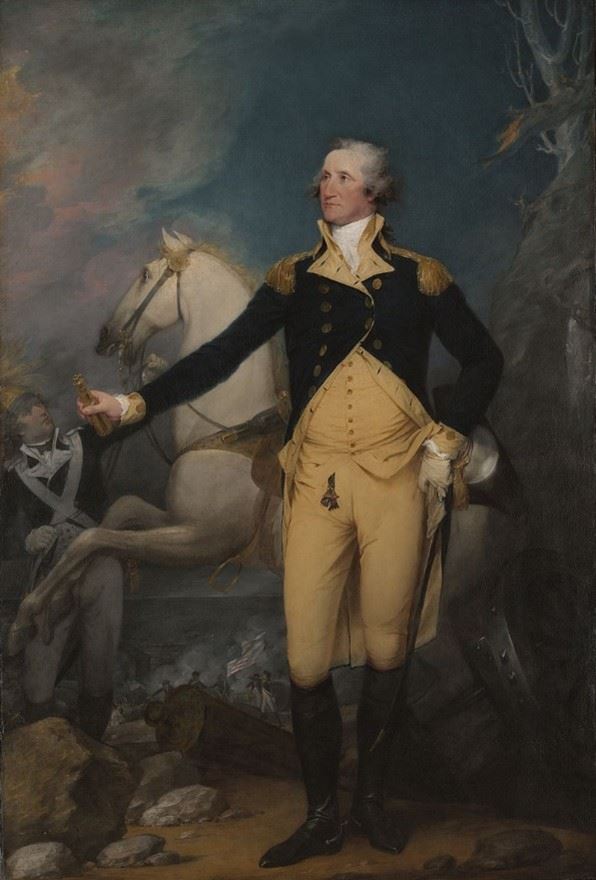
 

 Trenton Christmas 1


Q:  Have any of your members ever identified the colors flown by Washington’s forces on Christmas night 1776?  My theory is based on the John Trumbull painting of Washington at Trenton: white & red striped flag with blue canton, 12 six-pointed stars in a circular pattern with a single six-pointed star in the center. — Philip Jerome Brezovic

A:  It is highly likely none of Washington’s troops carried any colors, standards, or flags at the battle of Trenton.  His Order of Battle consisted of approximately 72 higher commands, regiments, battalions, detachments, or other units of severely reduced strength, moving under adverse conditions, across a river, at night, in a sleet storm, operating under orders to carry as little as possible to accomplish a surprise attack and a planned quick retreat.  The stands of colors were probably left in camp with the headquarters baggage.


Of the recorded units participating in the attack, only two are known to have had colors at that point in time, the 1st Pennsylvania (Rifle) Regiment and the Philadelphia City Cavalry.  The 1st Pennsylvania was divided into two battalions, with 199 men armed with rifles with Lord Stirling’s Brigade and 254 men serving with Fermoy’s Brigade.  Since they were split, it is almost a certainty that neither carried the regimental flag.  A small detachment of 25 troopers from the Philadelphia City Cavalry was attached to Henry Knox’s Artillery, most likely to serve as videttes, that is, their duty was to convey messages between Knox and Washington and to scout enemy positions.  It is certain they had no flag in use for that duty.


At the time of the battle the Stars and Stripes was not yet designed and even after 14 June 1777, it was recognized as a naval flag, not a national color (as late as 1779, Washington was considering what the colors should be for his Continental regiments).  The Continental Army was still worried about basic supplies, such as food and clothing for the troops, especially shoes, and flags likely were not high on the list, and not an army-wide reality until after the arrival of Baron von Steuben in 1778.  Until 1778 or 1779, most units had no colors or they had makeshift colors; in 1775, for example, the Brunswick, District of Maine, militia joined the Continentals bearing a standard they made from a fir tree.  They stripped the tree of all of its branches except at the very top, reserving some that resembled a tree at the top of the pole.


Yet there are dozens of paintings depicting Washington and this event, nearly all of them showing flags.  Charles Willson Peale and other painters produced their paintings following the events, sometimes by many years.  In fact, painters of this era often produced multiple copies of their works, often showing different flags in each copy.  As a good example of this, John Trumbull is famous for his historic paintings, principal among them “The Death of General Warren at the Battle of Bunker’s Hill, June 17, 1775”.  But he painted a number of copies of this famous painting after the war and into the early 19th century.  Here are two copies to compare:
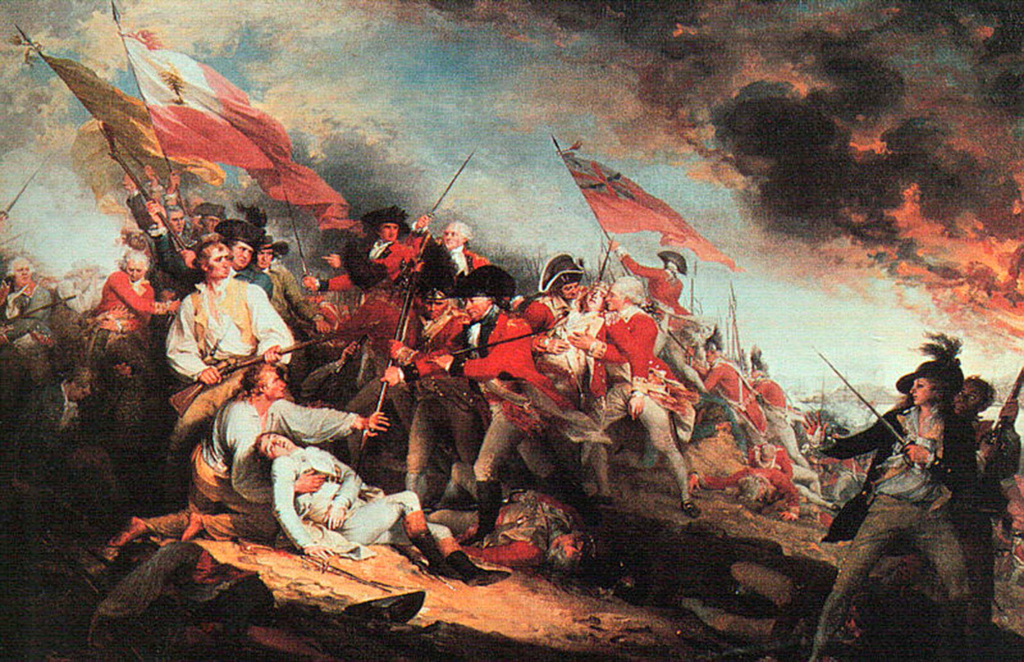
 

 Trenton Christmas 2     Trenton Christmas 3


As you can see, both the American and British flags are very different in each copy.  Which is more accurate? Probably neither.


Peale, likewise, made many copies of Revolutionary War scenes.  He also established a museum that featured these paintings, among other things, which he sold and then painted a new copy.  He died in 1827 and a number of his paintings are known to have been done in the early 19th century.  Unfortunately many of them cannot be precisely dated.  These paintings must be understood as allegory and not an attempt to accurately record history. Paintings are not photographs.  All too often Americans see these images through a 20th- or 21st-century lens, not understanding Americans of the 18th and 19th centuries saw these in a completely different light.


Your theory that the national flag was “white & red striped flag with blue canton, 12 six-pointed stars in a circular pattern with a single six-pointed star in the center” remains intriguing and unlikely.  This pattern may have seen some use, but not until after the adoption of the Stars and Stripes.  Additionally, the oldest datable image of a single-ring U.S. flag dates from the 1780s. — Dave Martucci (principal, Vexman Consulting Services) and Jim Ferrigan (curator, Zaricor Flag Collection).


1st United States Colored Infantry Regiment Flag (12/1/21)


Q: Did the 1st U.S. Colored Infantry have a flag?  I’ve struck out looking for information about it. — Elizabeth Brown, Reference Librarian, Library of Congress, Washington, D.C. (NAVA member)

A: The 1st United States Colored Infantry Regiment was one of the 160+ regiments of United States Colored Troops (USCT) raised by the Union during the American Civil War.  There is no record of a presentation of colors when it was mustered into federal service in Washington, D.C., on June 30,1863, nor is there a record about the disposition of its stand of colors when it was mustered out in North Carolina on September 29, 1865.


There is no reason to assume that the regiment did not carry colors; those colors probably did not deviate from the flags issued in 1863 to other Union regiments.  It is likely that the 1st USCT was issued a flag made in an army depot.  It would have had 34 stars either in rectilinear rows or the so-called “Philadelphia Oval” pattern.  The regimental color would have likely been another depot flag, issued blank; it was up to the regiment to paint the unit designation.

Sample Union Regimental Color 1863 Typical M-1863 Union regimental color.


There are several reasons why so few USCT colors are known and documented.  First, the U.S. War Department General Order #94 instructed troops to muster out where they were.  The 160+ USCT regiments were scattered all over the nation; the directive that mustered out units’ colors were forwarded to the governors of states.  Because the USCT were not, for the most part, state troops, these colors were eventually conveyed to the War Department and many ended up at the United States Military Academy at West Point, New York.  By the 1920s, many of these flags were in deplorable condition and were condemned and destroyed.  There is no record of what units’ flags were lost.

Another reason for the lack of documentation was that many of the USCT regiments had been raised in the states of the former Confederacy.  U.S. Army mustering agents were reluctant to turn regimental colors over to governors of former Confederate states, so the colors simply languished in storage at the War Department, eventually suffering the same fate as the West Point flags.


Finally, it was often customary for commanding colonels to regard these colors as personal, not regimental, property.  Some commanders took them home, where they often vanished until descendants rediscovered them. — Jim Ferrigan, Curator, The Zaricor Collection and NAVA treasurer


Understanding and valuing a black Gadsden variant (11/23/2021)


Black Gadsden Variant


Q: I’m interested in some information on a flag I own.  It’s not an antique (at least I think not). It is a fully black/white Gadsden flag variant that simply has the word “DONT” (no apostrophe).  I got this at a thrift shop in New York City years ago and have never been able to find any information about it. I t came framed and I have not wanted to take it out of the frame. There is no information on the back.  The flag itself is about 58”x35” (not including the fringe) and the frame is 66”x44” . Is this something you have seen before? — Felician Stratmann

A: Black Gadsden flags with this Preble-designed snake are available for sale today, usually described as having a black field representing “death/no quarter given”, somehow related to the pirate flag, the “Jolly Roger”.  The design has no place in historic fact.  The single word rather than the entire phrase is interesting and the first we’ve seen.   If it is fringed on all four sides, it isn’t really a flag in the traditional sense.  It is likely worth its replacement value. — Dave Martucci and colleagues


Wondering about Sullivan’s Life Guards flag (9/8/21)


Q:  Hi, I was wondering about a flag that I've seen commonly linked to Sullivan's Life Guard for the Revolutionary War, depicted featuring stripes and with a rattlesnake in the canton.  The only non-digital image I could find regarding this flag was in The Stars and the Stripes: The American Flag as Art and as History from the Birth of the Republic to the Present (Mastai, p. 22).  I was wondering if you had any more information about this design?  —  Elliot Weatherill


A:  The original flag is at the Rhode Island Historical Society.  Above is a rather fuzzy photo of it from the RIHS quarterly, Collections, published in 1925.  As you can see, it is in very poor condition; images of it in modern flag books are reconstructions.  According to Edward W. Richardson in Flags and Colors of The American Revolution, that publication is the earliest known record of this flag.  He comments that “There is no primary source information on the flag known to the author or to the Rhode Island Historical Society staff members contacted.”
 

According to Richardson, the flag was “reportedly carried by Sullivan’s Life Guards during the 1778 battle of Rhode Island”.  General Sullivan apparently did have a “Life Guards” company of about 300 men drawn from the Rhode Island troops that participated in the Rhode Island campaign of 1778.  However, I don’t think there’s any reference to them having a flag, and it seems unlikely that an ad-hoc unit like that would have one.


Some sources suggest that the flag was also carried during Sullivan’s campaign against the Iroquois in 1778–79.  However, I had a brief conversation with a colleague who wrote a book about that expedition, and he didn’t recall any mention of Sullivan having a personal guard during that period, or any mention of a special flag.  The bottom line is that we really don’t have any solid information about this flag’s history.  — Peter Ansoff, NAVA president


A:  The reconstructions of the flag are a bit of fantasy to a small degree; we can see just a tiny bit of the canton and it likely has a rattlesnake on it and a ribbon probably with some kind of motto.  There may be other emblems but there is not enough left to tell.  Nothing but hearsay connects it with the Revolution.  I am not aware if the RIHS has even had any analysis of the piece done and as far as I know it has not undergone any conservation treatments.  Likely there is less of it left today than the 1925 photo would suggest.David B. Martucci, past president, NAVA


Exploring a possible connection between black flags (9/8/2021)


A picture containing text, seat, sofa Description automatically generated


Q: I am trying to find some information or history regarding the Civil War “Black Flag” or “No Quarter” flag.  I've seen reference to an all-black American flag recently and wanted to know of any correlation.  FMAA has recently been receiving questions about this.  I have not been able to find any historical account other than a mention here and there that it relates to Civil War flags.  Can you help shed some light on the subject? — Meg Woody, Flag Manufacturers Association of America


A: So far as I know, the sale of sewn monochromatic U.S. flags as a stock item started with the Paramount Flag Company’s Flag Store in San Francisco in the late 1970s.  We offered them in red, white, blue, and black.  The monochromatic flags were the brainchild of the company’s artist, Jim Zook—he and I had been inspired by the cover of the 1973 book, The Stripes and Stars: The Evolution of the American Flag, by Boleslaw Mastai and his wife.  In turn, is likely that Mastai was inspired by the 1955 painting White Flag by Jasper Johns, in his famous flag series.


 Stars and Stripes Magazine Cover          


The modern synthetic all black U.S. flags seem to be recent to the marketplace.   

The Jetlifee Flags company of Montclair, Calif., makers of “Premium Flag Décor”, offers one:    

https://jetlifee.com/collections/all-decor-flags/products/black-american-flag-all-black-3-5ft. They also sell on Amazon and via Walmart.  Most appear to be made in China.


Several of the sites offering this flag describe it as décor.  Others refer to it as a “tactical” flag and others link it to the American Civil War.  This second claim is absurd.  During the war “raising the black flag” was a term understood to mean “No quarter given or expected”. The use of the term seems primarily metaphorical.  Stating that you would “raise a black flag” simply meant that your side would not offer quarter—you would fight until killing the enemy rather than letting him surrender—it did not mean an actual flag was raised.  However, there were known uses of actual flags colored black, or thought to be black, by both sides—but almost always flags associated with actual units.  In the Union Army the signal corps used all-black flags with a centered white square.  In the Confederate service the field of the so-called Hardee-style battle flag was a dark blue field, sometimes perceived as black. — James J. Ferrigan III, curator, Zaricor Collection and former retail sales manager, Paramount Flag Company


Identifying a variant Revolutionary-War-era flag (8/12/21)

A flag on a pole Description automatically generated with medium confidence

Q:  I have been trying to put an identity to a flag.  I’ve done a cursory search and found nothing, but I am a novice in vexillology, thus the request.  It strikes me the flag might actually be a spoof of some kind.  The flag itself was found in my brother Bruce’s collection.  There were no notes with the object or provenance of any kind. — John Baky


A:  I think this was a personal reconstruction of an American Revolutionary national standard executed in the style of that of the 2nd Continental Dragoons (see below).  This example substitutes a “Cowpens style” canton of a 12/1 starfield (twelve in a single ring with a center star) likely of personal significance to its designer. — Jim Ferrigan, NAVA treasurer

A 2nd Cont. Dragoons flag with a cross on it Description automatically generated with low confidence 
2nd Continental Dragoons Flag


A:  Looks like a mash between the Betsy Ross flag and Sheldon’s Horse (Second Light Dragoon’s).  I think it likely represents someone’s interpretation of the Continental Army Standard described as Washington’s preferred choice, “the stripes with the emblems in the center”. — David B. Martucci, past president, NAVA


A:  Although I could not find a written description or graphic depiction to match, in Edward W. Richardson’s book (Standards and Colors of the American Revolution, 1982) there’s more than one reference to flags with “...the emblems in the center...” design.   I concur with Dave and Jim...it appears to be a personal/one-off rendition... — Stan Contrades, NAVA 2nd vice president


Identifying and valuing an unusually shaped U.S. flag variant (7/31/21)

WW2-Era-Pull-Down

Q:  I work for an estate sale company in Melbourne, Florida.  We have a client that has brought us an old flag to sell.  It is more of a long parade banner as I understand it.  I cannot find anything like it, perhaps you have an idea of its value.  It has 24 stars, 4 red stripes and 3 white stripes; it measures 14” by 115”; it’s a cotton linen-type fabric; the stars are not embroidered; the white parts have turned more tea-colored with time. — Michele Means


A:  It is a WWII-era patriotic decoration known in the trade as a “Pull Down”, generally used in conjunction with fans and half-fans--they were often used as doorway and column decor.  They are still commercially available and are worth their replacement value. — Jim Ferrigan, former retail sales manager, Paramount Flag Company


Identifying an unknown religious flag (7/27/21)

A flag with a star on it Description automatically generated with low confidence


Q:  I have seen a flag hanging over several overpasses of the Long Island Expressway (I-495) in Queens, New York.  Do you have any idea what this flag represents (area, organization, movement, etc.)?  It appears to have the constellation Pleiades in the upper hoist and a Latin Cross in brush-stroke style in the fly. — Greg Hofer


A:  After consulting vexillologists globally, the NAVA Facebook group and FOTW correspondents provided an answer.  This is the flag of The Rock Church, described by some as a worldwide group of churches, by others as a cult. —Ted Kaye

A group of people posing for a photo with the Rock Church flag displayed
The Rock Church Flag displayed


Determining the star pattern of the 54th Massachusetts in the U.S. Civil War (6/24/21)

  55th Massachusetts (likely similar)

Q: I have had difficulty in my research and contacts to determine the star pattern in the canton of the flag that would have been carried by the 54th Massachusetts in its assault on Battery Wagner near Charleston during the Civil War. Even looking for it in the movie Glory was without success. — John McCarter


A:  It is generally thought that the national colors of the 54th were similar to those of the 55th (see image above).  — Jim Ferrigan, curator, the Zaricor Collection


Identifying flags in New York City artwork from 1931  (6/17/21)


Q:  I am an intern studying Florine Stettenheimer’s The Cathedrals of Fifth Avenue (1931) (see full image).  On the left hand side of this painting you can see three flags—one of them is clearly the American flag, but I am having difficulty identifying which countries the other two flags represent (assuming they’re real flags at all—the small parade right by these flags is celebrating the arrival of Charles Lindbergh in the small blue car with flowers, however).  Do you know which two nations are represented by the green flag with the headdress and the yellow/blue/white flag?  — Robyn Fohouo, Metropolitan Museum of Art

A:  The blue/white/orange flag (shown in reverse) is New York City's.  (see FOTW)  — Ted Kaye, NAVA secretary

   A group of people posing for a photo Description automatically generated


A:  The green flag may be some variant of a flag intended to represent the Improved Order of Red Men.  The headdress seems somewhat similar to icons used by that fraternal order in the past and the order was quite popular before the second World War, especially after Governor Franklin D. Roosevelt of New York was made an honorary member; a photo of him in full headdress was distributed widely even after he became president.  Interestingly, a similar flag is available from the Zazzle online store.  — David B. Martucci, Flag Assessment and Appraisal Services


Dating a 13-star flag from Nebraska (5/31/21)


A flag with stars and stripes Description automatically generated with low confidence     A red and white flag Description automatically generated with medium confidence   

Q:  I am a curator at Ft. Atkinson State Historical Park north of Omaha.  I have been in correspondence with Dr. Matt Keagle about a 13-star flag that we found among our artifacts.  We know that the flag is at least from 1880 with some information from the donor (1910) but Dr. Keagle stated that the hardware takes it back earlier.  We have it at the Ford Conservation Center in Omaha for conservation work, and they have discovered that the unfinished side is the side that should be shown, but the unfinished side is the side that was displayed.  It was displayed in s school room from 1876 to 1910 and is tattered and patched.  Dr. Keagle is mystified by why the "wrong" side is finished and suggested that I contact you. — Susan Juza


A:  Photographic analysis is always sub-optimal, but the flag in your images appears to be a United States, wool, hand-sewn, 13-star flag, with a single ring of 12 with a center star starfield, composed of 13 single applique white 5-pointed cotton or linen stars finished with a heading and grommets for outdoor display.  Flags like this were very popular during the 1876 U.S. Centennial era, and the grommets are known to have been in use by that time.


The characteristic you call the “wrong” side is what I describe as the manufacturers’ obverse.  There was no convention in the 19th century for flag display, many manufacturers made their flags with what we call the reverse as the “makers” obverse or display side.  It was actually quite common.  — Jim Ferrigan, curator, the Zaricor Collection


Identifying a WWII Japanese Flag Taken in the Philippines (3/31/21)


Q: We are having a hard time identifying a particular flag in our collection.  The flag was recovered from an Imperial Japanese soldier during the campaign to retake the Philippines.  More specifically, the flag was recovered in the province of Cagayan, in northern Luzon in 1945.  The flag consists of a white field with a red eight-pointed star in the center.  The star is enclosed by an open red circle.  One point on the star (the one pointing straight up) has a small red diamond affixed to it perpendicular to the direction of the star point.  Our records indicate the original donor believed it to be an Imperial Japanese Army unit flag.  Any help in identifying this flag, or indicating any resources that may lead to its identification, will be greatly appreciated. — Reagan Grau, Director of Collections and Exhibits at the National Museum of the Pacific War in Fredericksburg, Texas

A: The flag is considered to be a “sign flag” granted by the Maritime Bureau.  “Sign flag” means a flag indicating that the ship is registered with the Maritime Bureau.  According to military decree, it is displayed as a "sign (標識)" indicating that it has been registered.  Therefore, it translates into English as "sign flag (標識旗)".  Another translation would be "signal flag”.  The Imperial Japanese Army established a military administration in the occupied Philippines, Borneo, Malay, and Java.  A Maritime Bureau was set up to coordinate shipping operations in the southern region.  It was an external bureau of the Imperial Japanese Army's military administration.  Civilian vessels (ships that did not belong to the Army or Navy) registered their operator, tonnage, and specifications with the Maritime Bureau.  The ship was given a registration number, a registration document, and a sign flag.  By raising the sign flag, the registered vessels were able to operate freely outside the sea areas where the military prohibited them from entering.  The design of the sign flag was not mentioned in the official document, which makes conclusive identification of this flag difficult.  But from "registration number No. 217 (登録番号第217号)" in the lower left corner it is likely that this is the sign flag granted by the Maritime Bureau.  Moreover, the compass mark is also a symbol that matches the name of the Maritime Bureau.In addition, since it is a flag given by the military administration organization of the IJA, it does not contradict the museum record that it was taken from IJA soldiers. — Kazutaka Nishiura, member of JAVA, the Japanese Vexillological Association

NAVA experts (Stan Contrades & Jim Ferrigan) add:

Red compass rose in a circle on a white flag

A similar flag, sold in November of 2013 at Echoes of Glory in Virginia Beach, was identified by the auction house as an "Imperial Japanese Army Coastal Defense Flag" with attribution to the consignor.  This clearly seems to be the inspiration for the modern Japanese Coast Guard.  We are somewhat dubious of the "Army" attribution by the auction house.  The central emblem, without the circle, seems a close match to a Japanese Merchant Marine College emblem...and many Merchant Marine cap and rank insignia.  However, that merely shows commonality with this flag.  The National WWII PT Boat Museum posed the same question to FOTW in 2009: UFE09-4. “Japan Merchant Marine College-like Flag”.  It was not successfully identified then.  We’ve now seen four examples of this flag, which confirms its broad use.

Exploring connections between the symbols of imperial Iran and the British South Africa Company (1/4/21)

BSAC Flag 
Flag of the Imperial State of Iran, 1933–1979

Q: I am a U.K. citizen living in Indonesia.  While researching 20th-century imperial Iran, I noticed that the lion at the center of its flag bears a striking resemblance to a lion that appears on the emblem of the British South Africa Company.  The only difference being that the former is holding a scimitar whilst the other, a tusk.  Would you know if one is a derivative of the other, or is the similarity purely coincidental? — Christopher Starkey

A: Comparative vexillology is sometimes tricky, and it’s tempting to postulate an association between iconography featuring similar designs, colors, and symbols.  Your problem is compelling and merits more consideration than a simple “yes or no” answer.

Lions are integral to heraldry.  In A Complete Guide to Heraldry (1909), the eminent heraldist Arthur Charles Fox-Davies wrote, “Heraldic art without the lion would not amount to very much, for no figure plays such an important or such an extensive part in armory as the lion, in one or another of its various positions.”  No animal appeared more on heraldic devices.  To avoid confusion and create distinction, lions were placed in various poses or attitudes.  By manipulating a lion’s posture, head, torso, and tail, dozens of combinations were possible. Ottfried Neubecker in Heraldry: Sources, Symbols, and Meaning (1976) identified over 50 distinct leonine attitudes.

BSAC Emblem Emblem of the British South Africa Company (with the lion in question)

The lion on the British South Africa Company flag had a passant-guardant attitude.  That is, the creature’s hind legs are grounded, with a foreleg grounded and its other raised, clutching a tusk its right paw.  The lion featured on the BSAC flag was derived from its organizational heraldry.  In heraldic terminology, the lion is a crest, an adornment placed over the arms’ central shield or escutcheon.

The association of lions on English state iconography perhaps dates back to King John's royal seal (ruled 1199–1216); the practice continues into the present.  One need only examine the royal arms of Queen Elizabeth II to see this.  Its crest also features a passant guardant lion, albeit lacking a tusk.  This armorial accessory was employed by the Hanoverians long before Victoria succeeded to the throne in 1837.

Likely, the British South Africa Company’s lion was a pastiche of African and imperial iconography.  That said, I believe the lion featured on the BSAC flag is a direct allusion to the Crown and royal authority.

British South Africa Police Shako British South Africa Police Shako, ca. 1920 (with the lion in question)

The BSAC lion enjoyed a long lifespan.  It persisted in the Rhodesian military during the 20th century after its annexation in 1923.  In another example, the British South Africa Police used a similar lion in various forms from 1889 to 1980, notably on its shako (a military cap, usually with a visor, sometimes tapered at the top, often adorned with an ornamental plate or badge—in this case, a lion symbol—on the front). 

Likewise, lions are an exciting topic, rich with history and meaning, in the Middle East.  In the case of Iran, lion iconography was employed long before its association with English royalty.  You may reference the excellent article “Flags of Persia” in Encyclopaedia Iranica.  Lions had an association with Parthian rulers (who ruled from the 3rd century BCE to the 2nd century CE) and were also utilized by Arab, Mongol, and Ottoman polities.  Persian lions were depicted in various attitudes.  The sun-and-lion symbolism dates to Safavid Iran, which ruled from the 16th to 18th centuries.

The Iranian lion in question, a passant-guardant animal brandishing a shamshir, did not appear until the 19th century under Mohammad Shah Qajar (reigned 1834–48). The Qajar Dynasty ruled from 1789 to 1925, well within the period the BSAC operated in Africa.  A royal decree in 1846 proclaimed employment of the ancient Zoroastrian symbols of lions and suns, perhaps an official effort to situate Safavid authority in transhistorical continuity with ancient Iranian states.  During this period, the lion image was affixed to a tricolored flag; green and white are associated with Shia Islam, while the symbolism of red has been disputed.

Is it possible that the two symbols are linked?  Of course.  Both characters are products of the 19th century and represented entities that bordered the Indian Ocean.  The flag of Sri Lanka also features a lion brandishing a kastane, a short ceremonial sword.  Likewise, in various periods, Ethiopia’s flag featured a lion passant-guardant carrying a golden cross.

While the likeness between the Persian and BSAC lions is uncanny, a definitive answer would require extensive archival research.  Nonetheless, I’m comfortable stating that a relationship between the two is almost certain. — John T. Andrews, author of "Representing the Kingdom: The Vexillography and Heraldry of Hashemite Iraq,1921–58" (Raven 28)


Identifying a double-feather flag from WWII (12/21/20)

Give Double banner with two feathers, and other flags  

Q: We have what I believe to be a WWII-era “Double Victory” flag in our collection.  I am trying to verify that by identifying the maker’s mark which has been stamped on the flag.  However, I am having some trouble doing that as the mark is quite blurry from absorbing into the fabric.  Could you possibly point me to any resources that might help me identify the mark?  If it is indeed from the Double Victory campaign, it’s likely that the flag was made in the Pittsburgh area as the Double Victory campaign was started by the Pittsburgh Courier in February 1942.  You’ll also see the mark in the bottom right corner of the full flag image.  The flag is double-sided and you’ll notice that it has some paint damage (it appears to have been used as a drop cloth at some point in its life).  We purchased the flag at auction so we don’t have much information on it. — Patri O’Gan, Smithsonian Institution, National Museum of African American History and Culture.

A: That item you call a “maker’s mark” appears to be a “union bug”, a marking to denote that the flag was printed in a unionized shop.  This one is far to small and blurry to decipher.  Beyond that, you appear to be asking if we can help verify whether that flag is associated with the “Double Victory” campaign (winning the war AND winning civil rights).  It looks to me instead like a bond-drive or other fundraising flag.  I will consult our experts. — Ted Kaye

A: Your banner is not related to the “Double Victory” effort; rather, it is associated with the National War Fund.  The eagle on it was designed by Charles Coiner and adopted in 1941 for the National War Fund.  The idea behind the Fund was that with so many different organizations asking for money, one umbrella organization could collect donations and spread them out among the different needs.  As the war progressed, in different parts of the country it was known variously as the United War Fund, the War Chest, the United Fund, and the Community Fund.  It followed the existing model of the Community Chest (now United Way).  An example of the National War Flag (above) was made by Annin & Co. (the eagle looks black but is actually a very dark blue).  The feathers are a rendition of quills, used for writing with a pot of ink back “in the old days”.  The imagery was utilized extensively during World War II symbolically to link the people in that era with their Revolutionary War ancestors.  The thought process went something like “They had the courage to sign the Declaration of Independence for our country so you should have no problem signing up and pledging to support the country now.”  Most bond drives and other fund-raising drives involved making a pledge by signing one’s name and later making the payment (or having it deducted from one’s pay at work).  It makes sense for a drive to “give double” to have two quills.  The October 18, 1942 Pittsburgh Press full-page ad you also sent provides the answer.  The campaign for the United War Fund in Pittsburgh asked people to double what they previously donated. It didn’t have anything to do with the “Double Victory” campaign.  There were many local campaigns in different cities and states and we don’t have a good handle on the symbols used in all of them.  Above is a “cut sheet" for the NWF from early 1944 that could be bought and used in campaigns.  Notice the “union bug” at the lower left side of the page.  Thanks for sharing this.  I have never seen it before and it is a welcome addition to our knowledge of the symbols of this period. — David B. MartucciFlag Assessment and Appraisal Services

Thank you so much for these incredibly informative responses!  This is fascinating history—thank you for sharing.  I will be sure to pass this along to my colleagues as well.  Thanks to you and everyone at your organization for helping us to determine the true history of this banner.  It was a real pleasure working with you all. — Patri O’Gan, Smithsonian Institution, National Museum of African American History and Culture.
 
Investigating a 2nd Texas Infantry Guidon (11/18/20)

Guidon reading "Texas 2nd Infantry" on a blue panel with a white star and red and white tails

Q: I recently acquired a seemingly authentic flag from Texas 2nd Infantry, but cannot find anything like it online or through reverse-image searching. — Caleb Montag

A: It is highly unlikely that this flag derives from the 2nd Texas Infantry from the period of the American Civil War, for several reasons.  The style does not comply with any known Texas regimental flag.  It appears very small; genuine regimentals were much larger.  The stress seems caused intentionally instead of natural wear and tear.  The stitching is very primitive, almost too primitive, as early war flags were almost all made by women very skilled with a needle.  The stenciling is common to replicas (such as those recreated by veterans for patriotic and nostalgic purposes). — Jim Ferrigan
 
Identifying an Islamic-themed flag outside Walter Reed (10/12/20)

Crowd displaying many flags, including US, Trump and Turkistan 

Q: I have been watching the news about President Trump's visit to the hospital.  Among the flags being carried outside of the hospital was a light blue flag showing the Muslim crescent and star prominently in the middle.  I own a copy of The World Encyclopedia of Flags published by Anness Publishing Limited in 2004 but the flag is not pictured there.  Can you identify the flag for me? — William Schinkel

A: That is the former flag of East Turkestan, home of the Uyghurs, a Turkish-speaking Muslim group in northwestern China.  It’s a variant of the Turkish flag; the star and the crescent moon represent Islam and the blue represents the sky.  The flag is currently used as a symbol of the independence movement of East Turkestan (sometimes spelled "Turkistan") and Uyghur activists fly it in protests involving China's reeducation camp system in Xinjiang.  The flag's use outside Walter Reed National Military Medical Center when President Trump was a COVID-19 patient likely signified support for the Uyghurs against China.  In fact, the “East Turkistan National Awakening Movement” took credit for the flags, wishing Trump a speedy recovery and asking him to take stronger action against China for their treatment of the Uighurs. — Ted Kaye, NAVA secretary
 
Determining the color of semaphore flags used at Pearl Harbor in 1941 (10/9/20)
Diagram from a semaphore handbook     Two semaphore flags divided diagonally red over yellow

Q: My grandfather was a signalman on the USS Solace during the attack at Pearl Harbor.  I want to know what color the semaphore flags were at the time.  I believe they were red and white, but they have since changed to red and yellow. — Craig Lammes

A: In December 1941 U.S. Navy semaphore flags were red and yellow or blue and white, according to the Bluejackets' Manual, 1940, p. 103.  At the time the U.S. Army used diagonally-divided red and white semaphore flags.  Today semaphore flags depend on if the signals are sent by sea or by land.  At sea, the flags are colored red and yellow (the Oscar flag), while on land, they are white and blue (the Papa flag). — Dale Grimes, collector of WWII-era naval flags and Pete Loeser, historian
 
Returning a WW2 Japanese flag (9/9/20)

Japanese flag with extensive hand-written inscriptions 

Q: This flag (probably silk) was given to my father-in-law, who served in WW2, in Yokosuka, Japan.  A young boy gave it to him as he was walking through a neighborhood in August 1945.  Do you have any thoughts about it?  We were thinking about giving it to our favorite sushi restaurant. — Shirin Forsyth

A: This appears to be a Yosegaki Hinomaru (good-luck flag) carried by a Japanese soldier.  The flag may be of great sentimental value to his family, and thus have a higher use than display in a restaurant.  You might consider sending the flag to the Obon Society, a U.S. organization with a successful track record identifying and returning these flags to those families in Japan. — Ted Kaye

Understanding the “Confederate Flag” (8/6/20)

Confederate Naval Jack The "Confederate Battle Flag", actually the Second CSA Naval Jack

Q: Much confusion appears to surround the “Confederate Flag”.  What’s the story behind the flag we most often see?Many inquirers

A: The Confederate Flag most often seen today is the Second Naval Jack, but many flags are associated with the Confederate States of America (1861–65).  They include national flags in many variants, military flags, naval flags, and state flags.  In particular, C.S.A. forces used many different “battle flags” with different borders, star counts, etc.  Please see our Confederate Flag Facts for a more extensive explanation — The Executive Board of NAVA

I just wanted to congratulate NAVA for your "Confederate Flag Facts" document.  It's very well done, has much info in a short space, and deals with the topic in an objective way, seldom seen today.  I especially appreciate that you call the flag designed by W. P. Miles "The Confederate Battle Flag" while so many other insist on calling it "Battle Flag of the Army of Northern Virginia".  Since Confederate Senate flag acts Bills no. 132 (22 April 1863) and no. 137 (13 December 1864) both explicitly refer to this flag as “our battle flag” I always refer to it as the Confederate Battle Flag. It was in particular the Battle Flag of the Army of North Virginia but was also in general the Confederate Battle Flag: the fact that it was carried by infantry regiments from all eleven Confederate States plus three of the five Sister States suggests that the name “Confederate Battle Flag” is much more exact than “Army of North Virginia Battle Flag”.  The same remark applies to Miles’s design in a rectangular shape: most call it the "Flag of the Army of Tennessee" – which it was, also in particular – instead of the "Confederate Navy Jack" which it was in general, as described by the regulations issued by the Secretary of the Navy on 26 May 1863. — Louis-Pierre Smith Lacroix

 
Finding information and a source for military streamers (6/17/20)

Array of streamers on a U.S. Army flag 

Q: I'm building a retirement gift that includes the division's colors and associated streamers.  Is there a download for these streamers anywhere? — Ed Harm

A: Making some assumptions based on the content of your question, I offer the following:
  1. Since the question involves divisional colors, the presumption is you're asking about U.S. Army streamers (could be USMC).  If so, you may find the following website useful for the campaigns covered by Army streamers: https://history.army.mil/html/reference/campaigns.html
  2. As not all streamers may be for campaign service, some are awards, see Army Regulation 840-10: Flags, Guidons, Streamers, Tabards, and Automobile and Aircraft Plates; please refer to Chapter 9 (it covers all streamers authorized by the Army).
  3. If you are wondering what streamers have been awarded to Army units at various levels and time periods, the archived lists of streamer awards on the following webpage may prove useful: https://www.hrc.army.mil/content/Unit%20Award%20Info
We hope this helps you with your retirement gift preparations. — Stan Contrades, Col, USAF (ret)
 
Naming the oldest physical flag in the world (6/16/20)

Roman standard, 3rd-century AD  Iron Age proto-vexilliloid  Vertical pennon alternating red and white stripes 1238 

Q: I've been wondering recently what the oldest flag in the world is.  I don't mean the oldest design but rather the oldest physical flag that is still intact today, who used it, and where it is located. — Charlie Knox

A: There are several claimants to "oldest extant flag", one a reputed 3rd-century A.D. Roman standard in the Pushkin Museum in Moscow; another a metal Iron Age proto-vexilloid in the National Museum of Iran.  Other sources cite the Pennon of the Conquest of Valencia, 1238. — Jim Ferrigan
 
Identifying a flag with many national flags on it, flown at Rockefeller Center in the 1990s (6/2/20)

center of OAS flag depicting multiple furled flags

Q: In cleaning out my dad's house I came across a 10 x 15 ft. flag.  It hung at Rockefeller Center in the early 1990s and has several countries’ flags together on this one flag—it's beautiful.  The central circle is 8 ft. in diameter.  I know to the right person it would be a treasure. If you can provide me with someone who would know the value or would be interested in having it, I would be grateful. — Ann-Marie Bontempo

A: You have the flag of the Organization of American States.  Here is an image from the OAS website.  The flag especially interested me as I used it in the flag design guidebook Good Flag, Bad Flag as a negative example of challenging symbolism—it depicts the flags of all the member countries and must be changed each time one joins, drops out, or changes its flag.  You might be interested in a photo of member flags displayed at the OAS headquarters in Washington, D.C., which I took after our flag congress there in 2011—it appeared on the cover of our publication NAVA News.  If you are trying to sell the flag, you'd probably do best to offer it on eBay (and if you do, we could alert our members). — Ted Kaye
 
Explaining the ribbons on U.S. military flagstaffs seen on Memorial Day (5/25/20)

Trooping colors at Arlington

Q: What do you call the strips of fabric hanging at the top of some flags during outdoor ceremonies such as today's Memorial Day observance at Arlington National Cemetery?  The U.S. flag didn't have them, but the other flags did—maybe to keep them from flying in the breeze during ceremony? — Tom Riordan

A: You describe the campaign streamers attached to the staffs of the flags of the services of the U.S. armed forces.  They commemorate significant campaigns, battles, or actions in which the Army, Navy, Marine Corps, Air Force, and Coast Guard participated.  Campaign streamers (also called battle streamers) are 3 or 4 feet long (depending on the branch of service) and 2 3/4" wide and their color scheme often matches the corresponding medal or service ribbon.  The Army began using campaign streamers in 1920, then the Marine Corps (1939), the Air Force (1956), the Coast Guard (1968), and the Navy (1971).  A staff might hold up to 190 streamers. — Ted Kaye
 
Identifying a replica historic flag—possibly of Washington’s Headquarters (4/4/20)

Display of 6 Revolutionary-War-Era flags The flag in question is at the upper right

Q: There is a flag in a display at my work where 6 flags are depicted.  The flags include the Bennington flag, the Presidential flag, the Commodore Perry flag, the Betsy Ross flag, the 50-star U.S. flag, and what looks to be Washington’s flag.  However, Washington’s flag is missing the center star and I don’t know why.  Would there be a historical reason why the center star is missing? — Dusty Statler

A: The top flag on the right does indeed look like Washington Headquarters flag with the middle star missing.  The stars are also much "fatter" than the ones on the actual artifact.  I've never heard of a version with fewer stars, and it's hard to imagine why anybody would make one.  The original is at the Museum of the American Revolution in Philadelphia (in fact, the museum uses the star design as their logo), and it definitely has 13.  Also, the flag in the middle of the bottom row is curious.  It's not the presidential flag, which is blue rather than white.  It looks like the Seal of the United States on a white background, which is not used as a flag as far as I know.  The vice-president's flag is white, but it has the U.S. arms instead of the seal.  The modern version of the VP's flag also has 4 stars, one in each corner.  There was an earlier version that did not have the stars, but it still had the arms rather than the seal. — Peter Ansoff 

Identifying a flag in an image of George Washington and the Count of Rochambeau accepting British surrender in 1781 (2/28/20)

Image of British Surrender at Yorktown, with flags

Q: I am working on an exhibit about the Count Rochambeau in America.  I have a 1781 French print of him and George Washington.  The white flag behind Washington is the French flag but the other one, red in alternate corners and blue in alternate corners divided by white bands, is not known to me.  It appears to be like the present flag of the Dominican Republic (sans the coat).  Can you help me? — William Coles

A: The flag you seek to identify appears to be the standard of the (13th) Bourbonnais Regiment, one of four which landed with Rochambeau in July 1780.  In 1781 the regiment took part in the siege of Yorktown.  Its colonel was the Marquis de Laval de Montmorenci with the Viscount of Rochambeau (son of the count) as second in command.  The regiment and its colors appear (in tiny detail) in Van Blarenberghe's 1786 painting "Surrender at Yorktown".  Source: Standards and Colors of the American Revolution, Edward W. Richardson, U. of Penn. Press, 1982, pp. 150, 232. — Ted Kaye

Thank you so much—this answers my question and contributes valuably to the quality of my text panels for the exhibit!  Good luck with continued high-quality vexillology! — William Coles
 
Verifying “royal flags” flown on the SS United States when the Duke and Duchess of Windsor were aboard (1/25/20)

Burgee with red cross on white, overlaid with a crown        

Q: I have 3 royal flags (or pennants?) that flew over the SS United States whenever the Duke and Duchess of Windsor were aboard.  I was given them by the Executive Purser of the ship, Henry Moreno, many years ago.  When he retired from the ship lines, Henry and his wife, Stella, purchased our home in Eastham, Massachusetts, where they lived the rest of their lives, across the street from us.  According to Henry, he and the Duke and Duchess were very good friends.  He once told me that they would not sail on any other ocean liner other than the SS United States.  I would love to learn more about these flags and find out if they have any value. — Elizabeth E. Clark-Miller

A: The three pennants are those of the:
  1. Royal Yacht Squadron, United Kingdom
  2. Royal Danish Yacht Club, Denmark
  3. Real Club Nautico de San Sebastian, Spain
The Duke was a member of the Royal Yacht Squadron (UK).  I don’t know if he was a member of either of the others.  My best guess is these may have been hoisted in his honor simply because they had crowns on them, even though he had given up his crown, if, in fact, they were displayed at all when the Duke and Duchess were on board (it seems a little far-fetched to me).  Indeed, protocol, certainly something the Duke would be very familiar with, would dictate they would NOT be flown on a cruise ship unless it were sailing under a master or owner who was a member of these clubs...an unlikely scenario, in my opinion.  They are certainly NOT Royal Flags.  Their value as flags (apart from the connection with the Windsors) is minimal.  Their value as celebrity-related items would be better appraised by others. — David B. Martucci
 
Identifying a flag on a Victorian-era “woolie” held by Mystic Seaport Museum (12/9/19)

Square of fabric with  eight flags surrounding a central medallion below a crown

Q: In the course of developing an exhibit about sailor art, I've run across an image of a flag I cannot identify.  From around the 1840s through the 1910s, sailors embroidered wool pictures in their time at sea.  They frequently incorporated flags, probably of ports or places that they had been, into their designs.  This particular woolie (as they're colloquially known), was probably made by a British sailor (note the "V[ictoria] R[egina]" at the center top).  All of the flags have been identified, except the second flag on the left, between the flags of Britain and the Netherlands.

Detail showing flag with blue stripes and a central double-headed eagle

This unknown flag, as you can see, has blue, white, and blue horizontal stripes, and a gold double headed eagle in the center white stripe.  The woolie is badly faded—originally, the blue would have been a much deeper and more vibrant color.  I have focused mainly on national or naval flags, as all of the other flags on the woolie appear to be national flags.   Any help in identifying this flag, or suggestions of further resources that might help me to do so, would be greatly appreciated. — Mirelle Luecke, curator, Mystic Seaport Museum

Prussian flag--two black stripes on white with a central single-headed eagle

A: My guess is that it is an attempt at a flag either of Prussia or Russia.  The primitive nature of the flag depictions means wide disparities from actual flag designs.  Consulting with NAVA experts, the consensus is "Likely Prussian, perhaps Russian".  (It's more likely Prussian because of the stripe pattern.  Although Prussia used a single-headed eagle; Russia didn't use the double-headed eagle for maritime flags).  Prussia used black stripes. — Ted Kaye
 
Understanding how strings might be used to attach a vintage Cambodian flag (10/30/19)

detail of flag hoist with strings attached in three places

Q: I have a flag of the Democratic Republic of Kampuchea that has a unique string configuration on the sides that confuses me on the way that it would be hung.  It has 3 sets of 2 short strings on one side of it, and is from the late ‘70s to early ‘80s.  How would those be used to put this flag on a flag pole? — Ivan Wehner

A: From your description, it sounds like those ties are to attach the flag to a staff, rather than for hoisting on a pole.  That’s common in many countries. — Ted Kaye
   
Identifying flags on a 19th-century kite held by the Smithsonian (9/13/19)

Kite illustrated with a hot-air balloon and other designs

Q: The Smithsonian Institution's National Air and Space Museum has been offered a kite which features a painting of two men holding flags floating in a balloon.  It was most likely made somewhere in Europe in the 19th century.  I have been working to identify the two flags on the painting, but have been unsuccessful so far.  Would your organization be able to assist me in identifying the flags? — Thomas Paone, Museum Specialist, Curator for the Lighter-than-Air Collection, Smithsonian Institution National Air and Space Museum


A: I think these are fantasy flags, not actual designs.  Many objects of the 19th century had fantasy designs on them, sometimes weird variants of actual flags.  The one on the right may be a British type fantasy variant. Who knows? — David B. Martucci