

HomeFQ&A—United States National Flag

Flag Questions and Answers (FQ&A)

about United States National Flags

Determining the original arrangement of stars on the U.S. Flag. (9/5/26)

Flag of the Alliance Flag of the “Alliance” at The Texel Holland (painting); Dutch; Oct. 4, 1779. 

 Original at the Chicago Historical Society.


Q:  I am stationed at a U.S. military installation where, on occasion, historic U.S. flags are flown in order of adoption and use.  However, I am lacking authoritative information on which 13-star U.S. flag was used first:  the flag with the stars arranged in a grid pattern, or the flag with the stars arranged in a circle.   I have sought answers from the National Archives, the Smithsonian, and USA.gov websites but to no avail.  Could you please help me find a definitive answer on whether the grid arrangement or circular arrangement of stars was first used? — Lance Badoni

A: There was no standardized pattern for any U.S. flag until 1912. This includes 13-star flags which have been made and used ever since 1777.  Our past president, Dave Martucci, has done a survey of 13-star flags; the updated version is available at www.vexman.net/13stars/.   You can see that the earliest versions and depictions of the U.S. flag had stars aligned in rows (4-5-4, or the 3-2-3-2-3 pattern called the “Francis Hopkinson” design, after its designer).  It seems that versions with stars in a circle (the so-called but mistakenly-named "Betsy Ross" pattern) began to appear in 1782. — Ted Kaye, NAVA secretary 


Validating a flag flown on a D-Day vessel (7/2/26)

 Flag on D-Day Vessel


Q:  I have an exceptional collection of D-Day assault documents relating to a Y-1 Squadron minesweeper complete with a standard YMS-issue 48-star US ensign with a stamped 30-inch heading.  I would like to know if the flag appears to be an authentic World War II United States naval ensign and if its dimensions, construction, stamped 30-inch hoist marking, and four-grommet attachment arrangement are consistent with wartime issue to small naval vessels such as YMS-class minesweepers. The flag was retained by the commanding officer of a U.S. YMS minesweeper (Y-1 Assault Squadron, Operation Neptune) together with the original mailing and customs documentation from France in September 1944. Thank you and kind regards — Hermann Sommersell

A:  This appears to be an image of the reverse of a United States flag—48-star, natural fiber, machine-sewn, finished with a heading and four WW2-era white metal grommets.  Vestigial markings indicate that this was made as a Size #11 U.S. Navy ensign.  These should be further explored by utilizing a portable black light to read the now-faint markings. 

(Per USN specifications, Size #11 flags were 2.37’ on the hoist and 4.5’ on the fly.  NB: The government allowed variances on all textiles.)

The four white metal grommets are indicative of a USN yard-made flag or a contract flag.  The white metal also indicates manufacture between 1942 and 1945.  The rectangular reinforcement patch in the upper hoist is original construction and not a repair.  The flag is in fair condition and exhibits severe exposure to weather and outdoor use with corner wear and fabric loss, all entirely consistent with continuous use in a marine environment.  The size is entirely consistent with other Size 11 flags being issued to smaller craft of the U.S. Navy.  The chain of possession is reputed to be direct from the commanding officer, which supports the flag’s authenticity.

In conclusion:  The ensign appears to be an authentic World War II United States naval ensign.  Its dimensions, construction, marking, finishing details, condition are consistent with wartime issues to small naval vessels such as YMS-class minesweepers.  YMS (Yard Mine Sweeper) class vessels — including units of the designated Squadron Y (often referred to in archives as the Y-1 Assault Squadron or Squadron Y) — led the first Allied ships across the English Channel on June 5–6, 1944, clearing vital fire-support and transport channels under enemy fire for D-Day. — James J. Ferrigan III, curator, The Zaricor Collection.


Evaluating Two 45-Star U.S. Flags (4/5/26)

45-Star US Flag   45-Star US Flag Detail 1   45-Star US Flag Detail 2


Q: I have two 45-star flags. From all I have read, they are not reproductions. I would be interested in finding the value and possibly getting them sold. Please point me in the right direction. Thank you! — Sherri Smith

A: These appear to be two, 48" x 79" (reported) sewn, wool, 45-star, double-applique zig-zag canton, finished with heading and grommets, that bear evidence of having been tacked to staffs for display. There is no visible maker’s mark, but they betray professional manufacture and are marked "4 7", likely a reference to the dimensions. These markings would show the flag’s size when folded on a shelf in inventory before a sale to the end-user. The numerals likely stood for "4 feet by 7 feet."

The 45-star U.S. flag was official between 1896 and 1908, during which the Spanish American War occurred; accordingly, they are not uncommon. Such 45-star U.S. flags with no provenance sell in the $150 to $500 range, depending on condition and size. Flags associated with events of the Spanish American War have sold at auction for $5K USD and beyond. — James J. Ferrigan III, Curator, The Zaricor Flag Collection.


Determining the value of a 42-star U.S. flag (1/22/26)

42 US Dancing Star Flag


Q: I have a 36” x 53” 42-dancing-star flag. It is cotton gauze, with a machine-stitched hem with 2 small holes in a corner, minimal fading, slight tears in the two corners from hanging, and an unknown signature on the binding. Would you know the value of this and where I should sell it? — Kelley R. Small


A: This appears to be cotton sheeting, dye-printed, professionally made, outdoor, 42-star United States flag of the style and type available for only about eight months between 11 November 1889 and 3 July 1890. As a result, the 42-star flag was never officially adopted because Idaho joined the Union as the 43rd state on July 3, 1890, just one day before it would have become official. This makes such flags collectible, though smaller printed versions are moderately common compared to rare hand-sewn or large wool variants.

The star field is rectilinear with six horizontal rows of seven 5-pointed stars each. The rows are oriented with one point alternating to the hoist and fly, starting with the hoist. The reported size is 36” X 53” which by the 1890s was becoming a standard production hoist size. This could have been an early kit flag. There are some indistinct markings on the hoist, likely the previous owner. The flag appears to be used but still supports its own weight and seems to be in relatively good condition, exhibiting some fading from display. This is a nice size for collecting as it is large enough to display but can still be reasonably framed.

The values are more art than science, but similar flags have sold in the US$800–2,500 range. Options for sale are eBay or Etsy, a local antique store that would take in on consignment, or consignment to an auction house. — James J. Ferrigan III, curator, The Zaricor Collection


Identifying a large 36-star U.S. flag and a burgee (8/21/24)

36-Stars     

Q: I have two flags; to my understanding, neither has ever been authenticated.  The American flag has 36 Stars and measures 7 by 12 feet (approximately) and has been in my family for at least four generations.   I did not take measurements of the other flag in the frame.   I would love to know the process about having both flags authenticated and restored (if possible). – Andy Wittman, Long Island, New York


A: This appears to be a 7’ x 12’ (size reported) wool, sewn, outdoor, U.S. flag of the type that became current after Nevada was admitted to the Union on 31 October 1864, and officially flown on 4 July 1865, the first Fourth of July after statehood.  The stars are applique, but the photographs do not allow determining whether they are single- or double-applique. The flag seems to be professionally made, or at least sewn by a seamstress or sempster skilled with a needle.  The hoist, seams, and finishing all appear professional.  It may have some value, but without provenance it will be modest.  Also, the size is a liability as framing and glazing such a large flag would be expensive.

The second flag appears to be a framed mid-20th-century example of a U.S. Navy Burgee Command Pennant.  These were worn (flown) by the officer commanding a division of ships or craft or a major subdivision (e.g., a group) of an aircraft wing who did not have flag rank.  It is white with red stripes on the upper and lower edges and the number of the command (11) in red Arabic numerals.  Although still carried on the regulations it is likely that these are no longer used given the U.S. Navy’s current size and structure.  The U.S. Navy supply system provides only the basic pennant, and the local command sews or paints on the appropriate numbers, so the appearance may vary and often be crude, but still functional.   This example is of an unknown size and fabric, and the hoist and attachments seem to have been removed, a common occurrence for those unfamiliar with framing such flags. – James J. Ferrigan III, curator, The Zaricor Collection.


Valuing a 22-star U.S. flag (8/6/24)

22-starFlag

Q: Is there a way to determine the value and marketability this flag from this photo? – Mary Gray


A: This appears to be a variant of a U.S. 22-star flag of indeterminate fabric. The canton is oversized, descending 10 stripes into the field as opposed to the traditional 7 stripes.  The multi-directional stars are arranged in five horizontal rows of 4-5-4-5-4; the fabrics used are indeterminate.  The flag is finished with a sewn-in rope header; the stars appear to be sewn but whether single- or double-applique cannot be discerned.  The stitching could be either by hand or machine.  The flag appears to be used or stressed, but whether intentional or through legitimate use cannot be determined. 

The 22-star flag was never official; Alabama was admitted as the 22nd state on 14 December 1819 and Maine was admitted on 15 March 1820, so such a flag would have been current for less than 100 days.  Genuine period flags in this star count are extremely rare.  Some later-period exclusionary flags from the Abolitionist and Civil War periods appear have 22 stars, but they, too, are extremely rare.  Much better images would be needed for further analysis.   It is possible that it is not an old flag, but rather a replica made to look old.  Examination of the fabric and stitching would help sort that out. – James J. Ferrigan III, curator, The Zaricor Collection.


Evaluating a 15-star, 9-stripe U.S. flag (6/21/23)


Q: I know absolutely nothing about flags.  I recently have acquired an old American flag with 15 stars and 9 stripes.   Unfortunately, it is in quite poor condition but does look extremely old. It is approximately 24" x 36".  I was wondering if you could give some insight into whether it may be of any historical significance or just an old flag. — Daniel Scarlett


A: The flag looks modern and perhaps stressed intentionally.  It is machine-sewn and the weave looks like it might be a synthetic.   We guess it is an attempted replica of “folk art”. — Jim Ferrigan, curator, The Zaricor Collection.


Understanding a 54-star U.S. flag (6/20/23)


Q: I have an American flag from my grandfather’s estate.  He was a soldier in World War I. It is large and has 54 stars.  It's old and therefore a little tattered.  I was wondering if you had any information? — Michael Gnoth.


A: Flags like your United States 54-star flag are known to the flag community.  Flags with greater or fewer than the official number of stars constitute an interesting phenomenon.  
There are several reasons why flag makers might alter the star count.

  1. They are Inclusionary or Exclusionary Flags, which include or exclude other states for any number of reasons.  Two of the most common reasons were slavery and woman suffrage (showing stars for only non-slave states or those which had granted women the right to vote).
  2. They are Irredentist Flags, a term coined by the Canadian vexillologist Kevin Harrington (1934–2023) to describe flags with devices (stars) representing entities or territories not yet under the dominion of the flag represented.
  3. They are Anticipatory Flags, a term coined by the American vexillologist Howard Madaus (1943–2007) to refer to flags made and used locally in anticipation of statehood, whether imminent or not.  These were common in the 19th century when the number of states changed more frequently.
  4. They are manufacturer’s variants, simple errors of production.
All 54-star U.S. flags seem to fall into the manufacturer’s variant category.  Your flag appears to be a lightweight cotton sheeting “kit flag” with sewn stripes and a printed star field.  These were inexpensive mass-produced flags, often made in great quantities during times of national patriotic fervor such as WWI.
The star fields on these flags were made from rolls of continuously printed stars in six horizontal rows.  All the flag makers had to do was cut these into U.S. cantons containing 48 stars.  However, there were often missteps during manufacturing, resulting in flags with 42 or 54 stars.  Combined with poor or lax quality control, these were eventually released into the marketplace, as a flag company would often rather sell variants rather than incur the extra cost to correct or destroy them.
Perhaps the best-known example of a 54-Star flag was the one illustrated in The Stars and the Stripes: The American Flag as Art and as History from the Birth of the Republic to the Present by Boleslaw and Marie-Louise D'Otrange Mastai, on p. 273.  After the authors died their collection was sold at auction in 2002; their 54-star U.S. flag fetched US$920, a high amount likely reflecting its association with the Mastais. — Jim Ferrigan, curator, The Zaricor Flag Collection


Understanding the star pattern of a 37-star U.S. flag (1/9/23)

37-Star Patterned Flag
 

Q:  I am a U.S. flag enthusiast.  I recently inherited a 37-star (6-6-6-7-6-6) flag and I can’t find a whole lot of information online.  I was told it is painted onto silk.  It’s about 23.5 x 35 inches and is preserved in a very heavy, high-quality frame.  I have the letter of authenticity, as well, in a sleeve on the back of the frame.  I’m curious about the star pattern vs. the “Betsy Ross” pattern I have seen online.  Any information you can provide would be greatly appreciated! — Doug Hitchens, Chambersburg, Pennsylvania

A:  The 37-star U.S. flag was official from 4 July 1867 to 4 July 1877.  However, “anticipatory flags” envisioned by entrepreneurs for the pending statehood of Nebraska, can be documented as early as 1865.  It is perhaps interesting to note that one was presented to President Abraham Lincoln by Gen. Benjamin Butler before he was assassinated.  At that time, there were no prescribed designs for the star fields.  A review of approximately fifty 37-star flags consigned to auction at major houses reveals that their star fields fall into four major subdivisions: rectilinear, circular, a diamond, or other. 

The vast majority are rectilinear, with most being some combination of five rows arranged in various combinations of three rows of seven stars with two rows of eight stars; or some combination of five rows of six stars and one row of seven stars.  The circular patterns are all double rings and some also have center and corner stars.  The diamond star fields resemble the 33-star so-called “Ft. Sumter Flag”, except of course for the star count.  The “other” category covers vernacular or non-professional flags with fanciful and unique star patterns like starbursts, stars encircling some device or altered 36-star flags.

Based on the images provided this flag appears to be a commercially dye-printed flag, likely silk, but possibly cotton. — James J. Ferrigan III, curator, The Zaricor Flag Collection


1876 38-star U.S. flag (11/27/22)

38 Star US Flag


Q: I have an 1876 38-star US flag. It is 2ft by 3ft. I got from my great-great-grandmother and I cannot find any information on it. Can you help me? Thanks. — John Bater

A: This appears to be a large parade flag, likely mounted to a staff at one time. It is a full-flag-print, probably on a cotton sheeting or heavy cotton gauze, most likely imprinted with a textile paint and was presumably made for the U.S. Centennial Celebrations.

Make makers made these, so that will never be known. They are not scarce as they were made in large quantities. You might have it professionally framed as a family heirloom. — Jim Ferrigan, curator, The Zaricor Flag Collection.


Authenticating a 13-star U.S. flag (10/11/22)

13-Star Unidentified

Q:  Can you help me authentic a 13-star U.S. flag?  It has 8 hand-sewn 5-pointed stars in a circle, 1 star in the middle, and 1 star in each corner; the condition is fragile.  I will be framing this flag for permanent display in my recreation room .— Dale Sorensen, Seattle, Washington

A: This appears to be a professionally made, machine-woven, wool, outdoor with heading and grommets, machine-sewn stripes with hand-sewn double-applique stars (arranged in a single ring of eight with a center star and four corner stars) 13-star United States flag.  Flags of this type of construction were routinely made by makers after the U.S. Centennial celebration in 1876 until the early 1900s.  They were popular for patriotic purposes for private display and décor and were popular among the boating public in lieu of a U.S. Yacht Ensign.  The condition of this example is poor to fair with several areas of loss.  Flags of this type in good to fine condition without provenance or attribution have been sold at auction in the $500 to $1,500 USD range. — James J. Ferrigan III, curator, The Zaricor Flag Collection.


Identifying a 4-star U.S. Flag (8/25/22)


Suffrage 4-star flag 1902


Q: Can you tell me what an American flag that looks normal but only has 4 stars in the blue box represents? — David Gonzalez


A: This is a replica of a historic flag, likely produced by NAVA business member Flags For Good.  In 1902, women's suffrage activists created their own version of the Stars and Stripes with only four stars (the American flag then had 45 stars), representing the four states in which women could vote by 1900: Wyoming (1890), Colorado (1893), Utah (1896), and Idaho (1896).  Suffrage groups often produced flags, postcards, and buttons with the number of stars corresponding to the states in which women had the vote—as a way to track progress towards and make the public aware of the status of women’s suffrage.  The Smithsonian Institution’s National Museum of American History holds one such flag. — James J. Ferrigan III, curator, the Zaricor Collection

Suffrage 4-Star Flag Poster


Identifying a 45-star “Grand Luminary” flag (7/18/22)
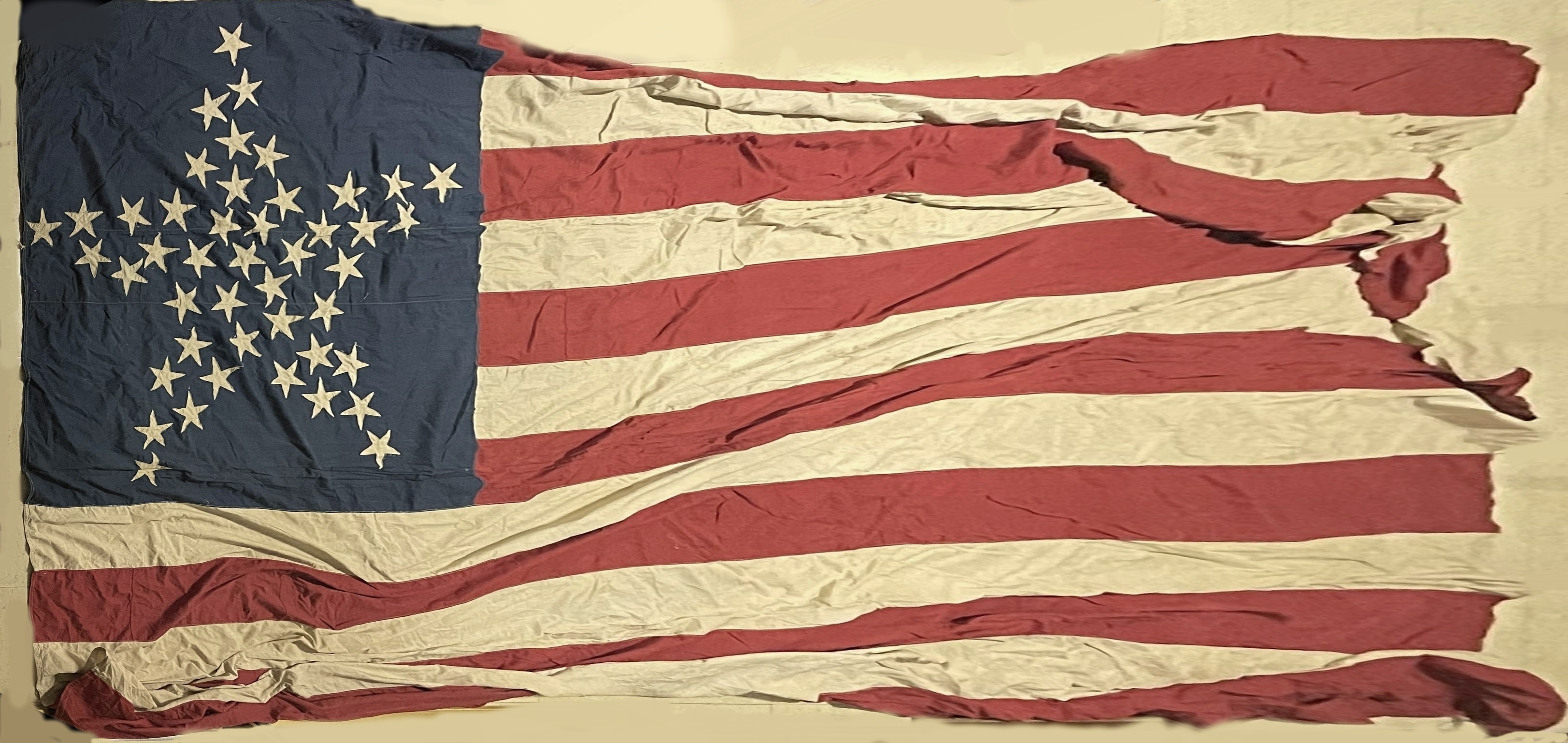


Q: I have found an old U.S. flag in our church that we are trying to identify. It is approximately 13’ x 8’, with 45 stars in an irregular star pattern. It was found at First Baptist Church in Columbia, Missouri. The church was founded in 1823. The flag likely came from a previous church building built in 1891 and razed in 1954, but no one has any memory of it. Any help will be appreciated. — Ken Hammann

A: This is a Grand Luminary flag. The 45 stars are arranged in the form of one great star, a “Grand Luminary”, a design championed by Captain Samuel C. Reid in 1817. He is reputed to have called it “The People’s Flag”. Reid held it to be the star pattern that would best represent the concept “E Pluribus Unum”, the national motto (Out of Many, One). The Grand Luminary star pattern, (sometimes called great-star or great-flower) represents the idea of the national motto, each star is separate and distinct, yet all work together to create a unified pattern, a union of states. They were at the height of their popularity up to the American Civil War, but their use persisted into the 1890s. The 45-star count was current from 1896 to 1908. — Jim Ferrigan, curator, Zaricor Collection

Q2: Thank you very much for this information. It helps us begin to understand what we have. May I take a little more of your time with a couple follow up questions? How rare is this flag? Were Grand Luminary flags made commercially or custom? Is the flag valuable? Is there any reason to think that it is not from the period 1896–1908? Is the size of this flag unusual? Thank you again for your help with this. — Ken Hammann

A2: As it was made toward the end of the period in which the Grand Luminary pattern was used, the flag is relatively rare—and with 45 stars it is most likely from the 1896–1908 period (sometimes “anticipatory” flags were made, expecting more states, but that's unlikely with this flag, as the 44-star flag had been adopted just 6 years before). It appears to be a vernacular flag (hand-made, not commercially produced) and unusually large. It may have some value, but the size is a liability (framing and glazing such a large flag would be expensive). Utahns might attribute more value, as it recognizes Utah's admission as the 45th state. If you want a professional appraisal, you can connect to our past president, Dave Martucci, at http://www.vexman.net/antique.htm. If considering a sale, you could approach our commercial member Jeff Bridgman, a dealer in such flags: https://jeffbridgman.com. Of course, you could decide to display it, carefully, on important church/national occasions! — Jim Ferrigan


Valuing a flag and pole from the Apollo program (4/2/22)

Apollo Moon Flag


Q: My father worked at NASA and made the flag assembly that was left in moon (he ran the machine shop and made the poles and latches). He also made three more. I believe the Smithsonian has one, the head of NASA had one; I have the 4th. Here’s an image of my brother in our back yard in 1972 with our flag. I would like to sell it. If you could help I'd be very grateful. — Richard Summers


A: This appears to be an Apollo Lunar Assembly Flag & Pole of the type utilized on the Apollo missions for the official EVA flag displays. I have no idea how many pole assemblies were made but it is likely that there were several extras for each Apollo mission for use in rehearsals, practice, back-ups etc. See Annie Platoff’s "Where No Flag Has Gone Before." Regarding auctions, at least one has come to this marketplace. It was lot 419 at the 21 April 2007 auction held by Regency Auction House of Rockaway, New Jersey. The hammer price was $9,775. — James J. Ferrigan III, curator, the Zaricor Collection.


Evaluating a 13-ftar U.S. flag (3/31/22)


Q: While I know that there were many iterations of the 13-star flag, I was wondering what, if anything, you could tell me about this one. Years ago, after my grandmother passed away, I found this folded up in a gallon-sized Ziploc bag. I have kept it as I found it while I try to find out more about it. Trying not to stretch it as it’s pretty frail, it measures 47.5ish by 29.5ish inches. I cannot tell what the grommets are made from. I see no kind of label or printing on the heading. I appreciate any information you can provide. — Kevin Price


A: You are correct — 13-star flags are not unique to the American Revolutionary War period; they have been made continually ever since. Your flag appears to be a commercially made, wool, outdoor, header and brass grommets, United States, 13 Star, Single Ring with Center Star and 4 Corner Stars flag, of the type popular in both the last half of the 19th century and early part of the 20th century. The flag was commercially sewn on a double needle machine, common among flag makers after approximately 1876 to the present day. The fabric appears to be an open weave wool bunting used for flags from the late 19th century until shortly after WWII. That starfield pattern was a popular style for patriotic, decorative, and parade purposes, originating in the early 19th century. Small (2.5' X 4') flags like this were also popular with the yachting public. — James J. Ferrigan III, curator, the Zaricor Collection.


Determining what House of Representatives building the 1818 Flag first flew over (1/20/22)

Q: I have not been able to find the answer to this inquiry: “According to a letter dated April 13, 1818, from HR Peter Wendover of New York to Captain Samuel Chester Reid, the new flag of the United States of America was received in the mail and promptly hoisted up a flagpole over the House of Representatives.  This flag was approved by the Flag Act of 1818, House Bill 32.  My ancestor, Captain Reid (1783–1861) was instrumental in the new design of the Flag.  Here is my question: Where was the House of Representative meeting in April 1818?  Since the Capitol Building had been burned by the British in 1814, Congress was meeting in the Old Brick Capitol.  Was the new flag hoisted over the House of Representatives of the Old Brick Capitol or over the House of Representatives of the repaired Capitol Building?”  — Betty Brown, Reference Librarian, U.S. Library of Congress

A:  According to the Architect of the Capitol website: The History of the U.S. Capitol, the Capitol was not ready for use again until 1819, so the House was meeting in the Old Brick Capitol in April 1818.  This doesn’t definitively answer the question, however—the flag could have been raised on the original Capitol even if the repairs were still in progress. 


A 1818 news article states the flag “was hoisted on the flagstaff of the house of representatives” which does not specifically say the flagstaff was on the Capitol itself.


There may have been a temporary flagstaff outside the Old Brick Capitol used when the House was in session.  It is even possible the “flagstaff of the House of Representatives” was not yet installed and was leaning against something somewhere temporarily, far from either Capitol (unlikely).


But an image of the Old Brick Capitol in 1815 shows no flagpoles.


And in a photograph of the Old Brick Capitol Building (taken many years after the events in question) there is no trace of a flagpole above any part of the building.

The Capitol has always had a wing for the House of Representatives and a wing for the Senate, each topped with a flagpole. 


By 1824 the U.S. Capitol flew two 24-star flags again.  The refurbishing work after the British burning was still going on; some workmen appear on the front landscape. 

Capitol Building 1824


Our best guess is that the new flag in 1818 was raised on the pole over the not-quite-yet-refurbished U.S. Capitol’s House wing.


— Peter Ansoff, NAVA president, & Dave Martucci NAVA past president


Connecting a 45-star U.S. flag to a community (7/5/21)


Q:  A distant relative just presented me with an authentic antique 45-star U.S. flag that is, in some vague way, associated with the community of Rouses Point, New York.  It was a prized possession of relatives, being passed on to my (now deceased) uncle and, ultimately, to me.  Might you have any idea as to what this might mean?  — Rick Short


A:  The 45-star pattern was officially in use 1896–1908.  While the era and star-count likely have nothing to do with Rouses Point, the flag may have been associated with an event or a location there.  It's a nice heirloom.  You could frame and exhibit it (depending on its size) or you could sell it (try our commercial member Jeff Bridgman American Antiques:  https://jeffbridgman.com/). — Ted Kaye, NAVA secretary

Such a wonderful reply.  Thank you for your wisdom, time, and enthusiasm.  I really appreciate this.  — Rick Short

 
Exploring the use of circular star-patterns on Revolutionary War flags (2/25/21)

U.S. 13-star flag, Illustration from Revolutionary War era.

Q: I am aware that there is a great deal of controversy around the Betsy Ross story, however my question is about the flag design itself.  The earliest depiction of a stars and stripes U.S. flag featuring a circular arrangement of stars is from William Barton's great seal design 1782.  With this being the case, I was wondering if flags with circular star arrangements were in use during the American Revolutionary War? — Elliot Weatherill

A: I think it’s safe to say that the short answer to your question is "probably not".  Just about all Revolutionary War-era depictions show the stars in rows or irregular patterns.  The circle pattern seems to have shown up much later, popularized by the 1893 Weisgerber painting of Betsy Ross.   If you haven't run across it yet, you might be interested in Dave Martucci’s page on 18th-century stars-and-stripes images, which has a catalog of known depictions with extensive commentary (The 13 Stars and Stripes: A survey of 18th Century Images).  As you'll see, he includes the Barton seal design as well as a couple of images that are more-or-less circular, but they're definitely a small minority and not really authoritative. — Peter Ansoff, NAVA President
 
Deciphering a tag on a 48-star U.S. flag (12/13/20)

Close-up of the corner of a U.S. flag with a tage reading "V S | Rose" 

Q: I have a 48-star American flag with a tag stapled on it.  The tag reads “VS | ROSE”.  I was wondering what that means. — Mark Palladini

A: The flag looks like a 1940s cotton, printed, sheeting kit flag.  The small paper item attached to the lower fly looks like a dry-cleaner tag. — Jim Ferrigan
 
Determining the history of a U.S. Flag with clues on the header (8/25/20)

Flag header inscribed "GOLDEN HINDE"     flag header incribed "Golden Hinde"     Flag header with postmark 

Q: I have a flag in my possession.  It’s an American flag with writing, stamps, etc. on it.  I’m unsure of what the meaning is and if the flag is of importance. — Mary Kate Walsh, Liverpool, England

A: We see on the heading "GOLDEN HINDE" and "PRESENTED TO THE GOLDEN HINDE AT PANAMA" and an apparent circular postmark/stamp "Golden Hind 7 Dec 197—".  We theorize that the flag was presented to the replica ship Golden Hinde II during her maiden voyage by a U.S. military or Canal Zone official when passing through the Panama Canal on December 7, 1974.  See this video of the event.  The ship is currently moored in London as a tourist attraction.  The flag is 3'6" x 6'7-3/4", which is a standard government size, and in official proportions (10:19).  It appears to be in pristine condition.  The fabric looks like the lighter-weight nylon commonly used for government-issued flags in the 1970s.  There may be some nominal collector value to the flag; although quite possibly the current staff of the ship might be interested in having it back! — Jim Ferrigan and Ted Kaye
 
Demystifying a U.S. flag with 48 stars and 15 stripes (7/11/20)

U.S. flag with 48 stars and 15 stripes

Q: I have a 48-star, 15-stripe flag that appears to be authentic and in good condition.  Printed on it is “3 X 5 FT / DETTRA’S FLAG PRODUCTS / STANTEST BUNTING FLAG”.  My neighbors found it in a shed rolled up and fastened to an old section of cane pole.  They believe it had been there for decades, and had belonged to a veteran that fought in WWI.  I'm trying to find information about this flag, its age, etc.  Is it possible that the flag manufacturer made it with extra stripes for a special occasion, event, or timeframe? — Bob Boyd

A: It is a manufacturing variant.  I have a good theory on how this occurred, based on my experience at Paramount Flag.   Operators of sewing machines at a flag company are generally arranged by both the task and its sequence in the manufacturing process.  While I've never seen this variant, I have seen 15-star cantons on 13-stripe fields, 50-star cantons on Bennington style stripes, and inverted starfields.  These often occur when an incorrect canton is inadvertently attached to the short stripes before being joined to the long ones.  This generally happens if a canton strays from one pile of the works in progress into another "production line”.  Most of these are caught along the way, and the "error" can be corrected.  Sometimes, they make it through production to inspection and labeling and they generally get pulled there.   Rarely, such a flag makes it all the way to packaging and inventory.  This is likely such a variant. — Jim Ferrigan (former retail sales manager of Paramount Flag Co. in San Francisco and currently the curator of the Zaricor Flag Collection)
 
Identifying U.S. Jack Flags from WWII (7/9/20)

U.S. Naval Jack from World War II--50 stars on a blue field Typical U.S. Naval Jack used during World War II.

Q: I’ve recently purchased a flag on eBay and would like to learn more about it. Do you know of a good source that discusses the manufacturers, production, and modification/evolution of U.S. Jack Flags during WWII? Most of the info I’m finding on the internet is from people trying to sell a product and does not have the information I’m looking for. — Chris Carey

A: Unfortunately there is no source like you are seeking.  Before 1946, flags for the Navy were either made at one of the Navy Yards or under a contract that required no manufacturer identification.  During the war, flags were made for the Navy at maximum production so even the Navy Yards did not mark every flag.  About the only identification factors to look for if there is no marking might be the grommets.  Although many flags lacked the markings, some grommets bore a stamp that consisted of an anchor and usually two digits indicating the year, for example “43”.  Often, however, there is only a single digit, usually “2”, that indicates the size of the grommet.   In 1942 brass was scarce so many Navy flags made that year had steel grommets.  Some of us are trained to be able to determine the manufacturer to some degree by observing the type of stitching and thread used.  But it’s much better if there’s a marking of some kind. — David B. Martucci, Professional Flag Assessment and Appraisal Services.
   
Understanding and valuing a 48-star U.S. flag (9/17/19) 

48-star U.S. flag

Q: I have an old flag with 48 stars and would like to know more about it, like how old it is or how much it is worth. — Carly Peckham


A: Your flag appears to be a 4' x 6', cotton, outdoor heading and grommet, “Defiance”-brand flag made by Annin & Co.   The flag appears to be used, worn, soiled, but intact and able to support its own weight.

The style of the label is from the 1940s or 1950s.  The cotton appears to be a sheeting rather than bunting, but the stars are sewn, which may indicate wartime manufacture.  I cannot see the grommets in great detail, but they might confirm the manufacturing era, as WWII-era flags would be more appealing to a collector.

Because of longevity (1912–1959—including two World Wars), 48-star U.S. flags are common and readily found at militaria, gun, and antique exhibitions.

The cost of a professional appraisal would likely exceed this flag's value.  If sale is the goal, an online auction site would be a logical venue. — Jim Ferrigan


Valuing a 48-star U.S. flag (2/26/19)


48-star U.S. flag

Q: I'm trying to find out the value of a 48-star “Bulldog” bunting flag.  It has 48 embroidered stars, 13 stripes, and measures 5’ x 9.5’.  It is "moth-proof best by test 2-ply warp and filling.  Dyed with everlasting dyes.  Dettra’s flag products."   I found it in my mother's cedar chest.  I believe it belonged to my great-grandmother’s husband. — Judy McPeak


A: Flags of this type from this manufacturer are common.  That particular size and fabric were commonly used as interment flags used to cover caskets.  Because of this they are readily available at militaria shows, gun shows, and antique shops.  More and more are coming to market as the “Greatest Generation” passes.

Valuation is dependent on authenticity, rarity, provenance, condition, size and person with whom associated.  Flags of this general type, 5’ x 9.5’ cotton interment flags, routinely sell in the $25 to $100+ range.  Collectors seeking flags specific to a certain maker, Dettra in this case, might pay more.  A recent search of eBay reveals that a similar flag to the one you described sold for over $220.

It may well be that the family sentimental value exceeds the monetary value. — Jim Ferrigan


Have a question to ask about flags? E-mail it into NAVA Flag Questions using your first and last name.